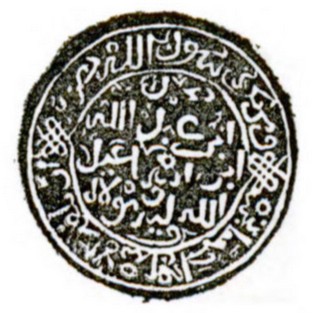
Empire Flag Eternal SovereigntyEmperor's Seal Sidi Mohammed III · 1786Celestial Seal Articles 20–25
EMPIRE OF MOROCCO
Ab Antiquo • Maghrib Al-Aqṣā • North Gate
1786 Mālikī Sharia Hiba (Sovereign Unilateral Grant) · Recorded at 8 Stat. 484 (1836)
This record stands under the Chapter 4 ʿAlāma of record — عَلَامَة بَيْنَنَا نَعْرِفُ بِهَا — “a mark between us by which we know” — the mark of recognition of the 1786 grant
The treaty, word by word — both witnesses, every flag published
The Interlinear of Record
The office's claim is that the Arabic governs the sense — and a claim that can be shown need not be argued. This page lays the 1786 sealed grant and its 1836 recordation open word by word: the Arabic of record with transliteration, gloss, and its facsimile-read confidence flag; the carried English quoted exactly as carried; and, on the doctrine-bearing words, summary cards of the Mālikī rules, the period authorities, and the maxims — every summary compressed, labeled, and pinned to its locus in the volumes of record, so that the page educates and the volumes complete.
The model. The interlinear apparatus follows the BibleHub model, enhanced and perfected for a legal-diplomatic instrument (the format of record, Article 21 prototype): where the reference model gives a Strong's number and a modern lexicon, this record gives period anchors — Khalīl's Mukhtaṣar, Johnson (1755), Blackstone, and the locked Volume D glosses — never an anachronistic lexicon; and every Arabic unit carries its confidence flag: [W] word-level verified on the certified facsimile · [S] phrase/strip level · [O] suspended (region confirmed positionally; word-form unresolved — it asserts no reading). The witnesses: A the 1786 sealed book · B the 1786 treaty-form face · 1836 the recordation's Arabic · E the 1786 carried English · E36 the 1836 English · L the Leiden literal.
The discipline. The carried English is quoted as carried — misrenderings are flagged, never silently fixed. Where the facsimile and a carried pin diverge, both are disclosed (see Article 25). Articles not yet transcribed are marked in course of transcription — nothing is printed ahead of the record, and our uncertainty is published, not hidden: a record that shows its flags cannot be accused of concealing them. Every summary ends at its locus: the full rule with its evidences lives in the volumes (the library of record) and is examined in the NI-Ijāzah course.
The witnesses of record — verify every word against the facsimiles
The facsimile arbitrates. Every Arabic panel on this page carries its page-pinned image cut from the certified reproductions of record, so the reader compares and verifies against the sources themselves — no trust in the transcriber required. The full certified volumes from which the images are cut are served free, verified byte-exact against the register of record:
The witness objects — comparison and verification layer
Witness object
What it carries
Access
DOR Appendix — Facsimile (DOR-AF)
The 1786 plates of record — the sealed book and the treaty-form faces (Miller, vol. 2, Document 14): Articles 12–25 at prints 198–211, folio ٢٤ at print 210, folio ٢٥ at print 211. Pin convention of record: PDF page = print − 183 (Article 20 → print 206 → PDF 23; Article 21 → 207 → 24; Article 22 → 208 → 25; Article 24 → 210 → 27; Article 25 → 211 → 28).
DOR-AF.pdf — free, served from this site of record 2026-09-12 (byte-identical to the register)
DOR Second Appendix — Facsimile, Parts 1–3 (DOR-2AF1/2/3)
The second-appendix facsimile tiers of record (see the library table for their contents and register hashes).
1 · 2 — on the bucket, public access restored 2026-09-12 · 3 — free, served from this site of record 2026-09-12
Miller, vol. 4 (GPO 1934), Document 81
The 1836 recordation — Arabic prints 34–59, English prints 60–66. The 1836 witness images on this page are cut from the full scan of record. Pin convention: physical page = print + 27 (Article 21 → print 55; Article 24 → print 58). The certified 1836 readings for Articles 3, 6, 15, 16, 19, 24 are entered of record in the 1836-Arabic transcription note of record, 2026-09-12.
page-pinned images below; the plates likewise underlie the DOR volumes
The grantee's own certified copy — the LoC-certified 1836 grant
The 1836 treaty as printed in the U.S. Statutes at Large (48 Stat. 484–487), certified by the Library of Congress Duplication Services on 2014-09-04 — the recordation's English (and its Arabic print) under third-party certification: 3,882,289 bytes, verified live 2026-09-12.
The 1786 carried English (8 Stat. 100 tradition; translator of record Issac Cardoza Nuñez) stands at the head of every article below, exactly as carried; the 1836 English (Miller, vol. 4, prints 60–66) is collated in the volumes of record. A LoC-certified 1786 English (8 Stat. 100–133) remains the one outstanding optional symmetry item — acquisition pending at the author's gate.
on this page, per article
The discipline of record. Every served object is byte-identical to a hash-recorded artifact of record; if a served file ever fails to match its register hash, the register — not the file — is the record. Pin correction of record (2026-09-12): the 2026-09-09 builder specification cites the sealed-book cluster at prints 198–206 and Article 21 at prints 198–200; the plates arbitrate otherwise — prints 198–200 carry Articles 12–14, the office-function cluster stands at prints 206–208, and the sealed book spans prints 186–211. This page carries the plate-verified pins; the tribunal page carries the author's specification copy verbatim under the verbatim-copy discipline, and a certified correction of that copy stands queued at the author's gate. The facsimile arbitrates.
The preamble
The preamble — the Emperor's declaration of the book
“In the name of Almighty God, This is a Treaty of Peace and Friendship established between us and the United States of America, which is confirmed, and which we have ordered to be written in this Book and sealed with our Royal Seal at our Court of Morocco on the twenty fifth day of the blessed Month of Shaban, in the Year One thousand two hundred, trusting in God it will remain permanent.”
— The 1786 preamble of record; the 1836 recordation’s own preamble is noted in the Arabic panel below.
بسم الله الرحمن الرحيم — الحمد لله
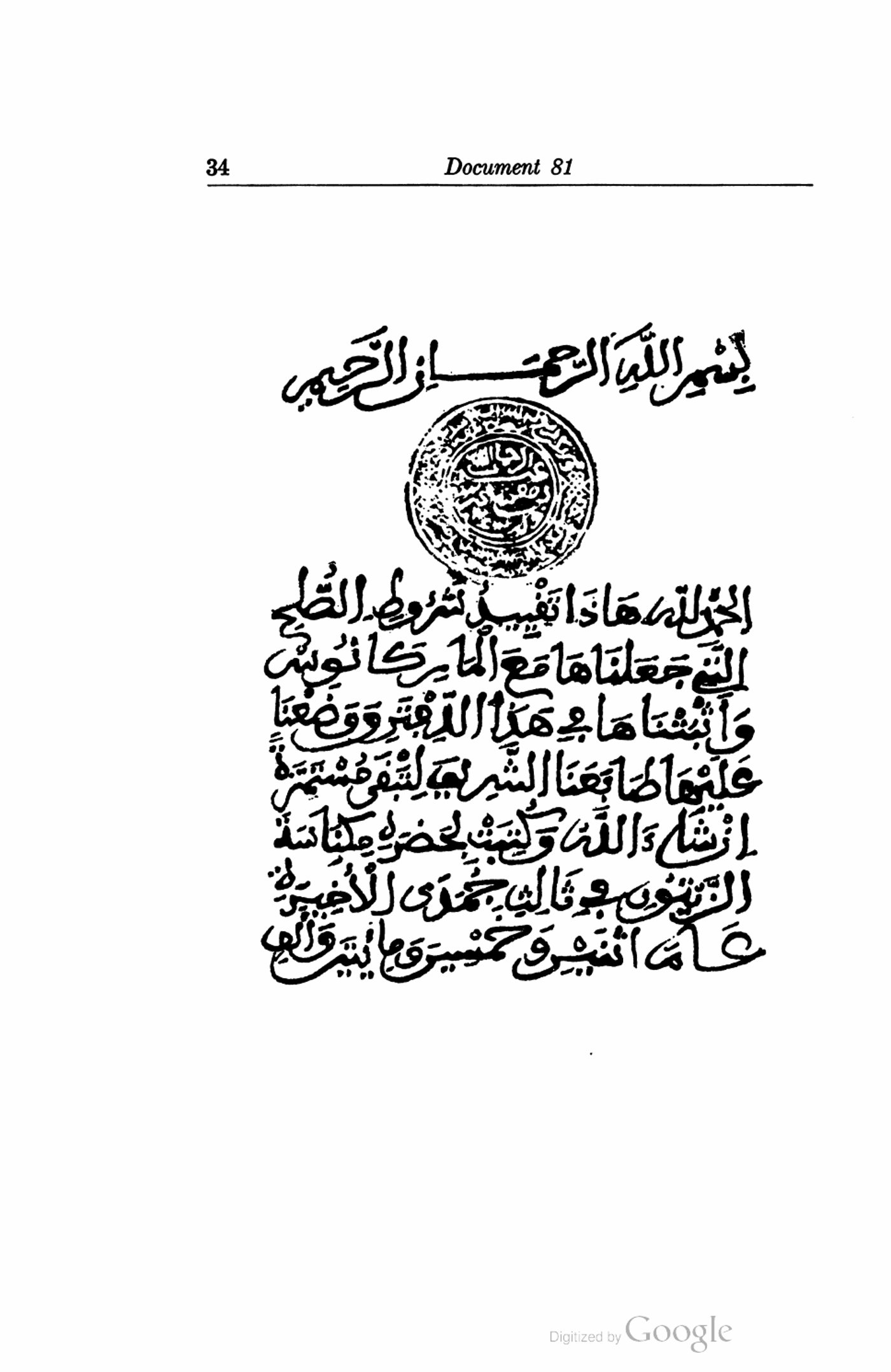
The 1786 sealed book opens with the basmala and the seal page (Miller, vol. 2; the book sealed at the court, 25 Shaʿbān 1200). The 1836 recordation opens: “In the name of God, the merciful and Clement! (Abd Errahman Ibenu Kesham whom God exalt!) Praise be to God! This is the copy of the Treaty of peace which we have made with the Americans; and written in this book; affixing thereto our blessed Seal, that, with the help of God, it may remain firm for ever. Written at Meccanez, the City of Olives, on the 3d day of the month Jumad el lahhar, in the year of the Hegira 1252 (corresponding to Sept. 16, A.D. 1836).” (Miller, vol. 4, print 60.)
The 1836 recordation opens — the imperial seal and the preamble page (Miller, vol. 4, print 34; cut from the scan of record).
Verify: the 1836 reproduction, Miller vol. 4, print 34 (physical page = print + 27) · the 1786 sealed-book opening, DOR-AF (PDF page = print − 183).
Word by word — the doctrine-bearing units
Arabic
Transliteration
Gloss and carried English
Flag
تَظَلّ دَائِمًا
taẓallu dāʾiman
“it will remain permanent” — the preamble’s own duration word, carried in the 1786 English as “trusting in God it will remain permanent”
[S]
The preamble declares the grant **permanent by its own words** — before any article speaks. That declaration is the anchor of the Article 25 adjudication: a duration cap meeting a grant already declared dāʾima is the repugnant condition that falls while the grant stands. **SUMMARY — the full rule with its evidences: ḤIBAH ch. 20 · CORPUS line 69 · the 2026-08-03 correction of record.**
Article 1 of 25
The book delivered to the agent — twenty-five articles
“We declare that both Parties have agreed that this Treaty consisting of twenty five Articles shall be inserted in this Book and delivered to the Honorable Thomas Barclay, the Agent of the United States now at our Court, with whose Approbation it has been made and who is duly authorized on their Part, to treat with us concerning all the Matters contained therein.”
— The 1786 carried English of record (8 Stat. 100 tradition; translator of record Issac Cardoza Nuñez, per Barclay’s certificate).
The Arabic interlinear for this article is in course of transcription from the facsimiles of record — the 1836 reproduction (Miller, vol. 4, prints 34–59) and the 1786 sealed book (Miller, vol. 2, prints 186–211). Each word publishes here as it is facsimile-verified; nothing is printed ahead of the record. The carried English of record stands above.
Article 2 of 25
No commission from the enemy
“If either of the Parties shall be at War with any Nation whatever, the other Party shall not take a Commission from the Enemy nor fight under their Colors.”
— The 1786 carried English of record (8 Stat. 100 tradition; translator of record Issac Cardoza Nuñez, per Barclay’s certificate).
The Arabic interlinear for this article is in course of transcription from the facsimiles of record — the 1836 reproduction (Miller, vol. 4, prints 34–59) and the 1786 sealed book (Miller, vol. 2, prints 186–211). Each word publishes here as it is facsimile-verified; nothing is printed ahead of the record. The carried English of record stands above.
Article 3 of 25
Prizes — subjects and goods pass free
“If either of the Parties shall be at War with any Nation whatever and take a Prize belonging to that Nation, and there shall be found on board Subjects or Effects belonging to either of the Parties, the Subjects shall be set at Liberty and the Effects returned to the Owners. And if any Goods belonging to any Nation, with whom either of the Parties shall be at War, shall be loaded on Vessels belonging to the other Party, they shall pass free and unmolested without any attempt being made to take or detain them.”
— The 1786 carried English of record (8 Stat. 100 tradition; translator of record Issac Cardoza Nuñez, per Barclay’s certificate).
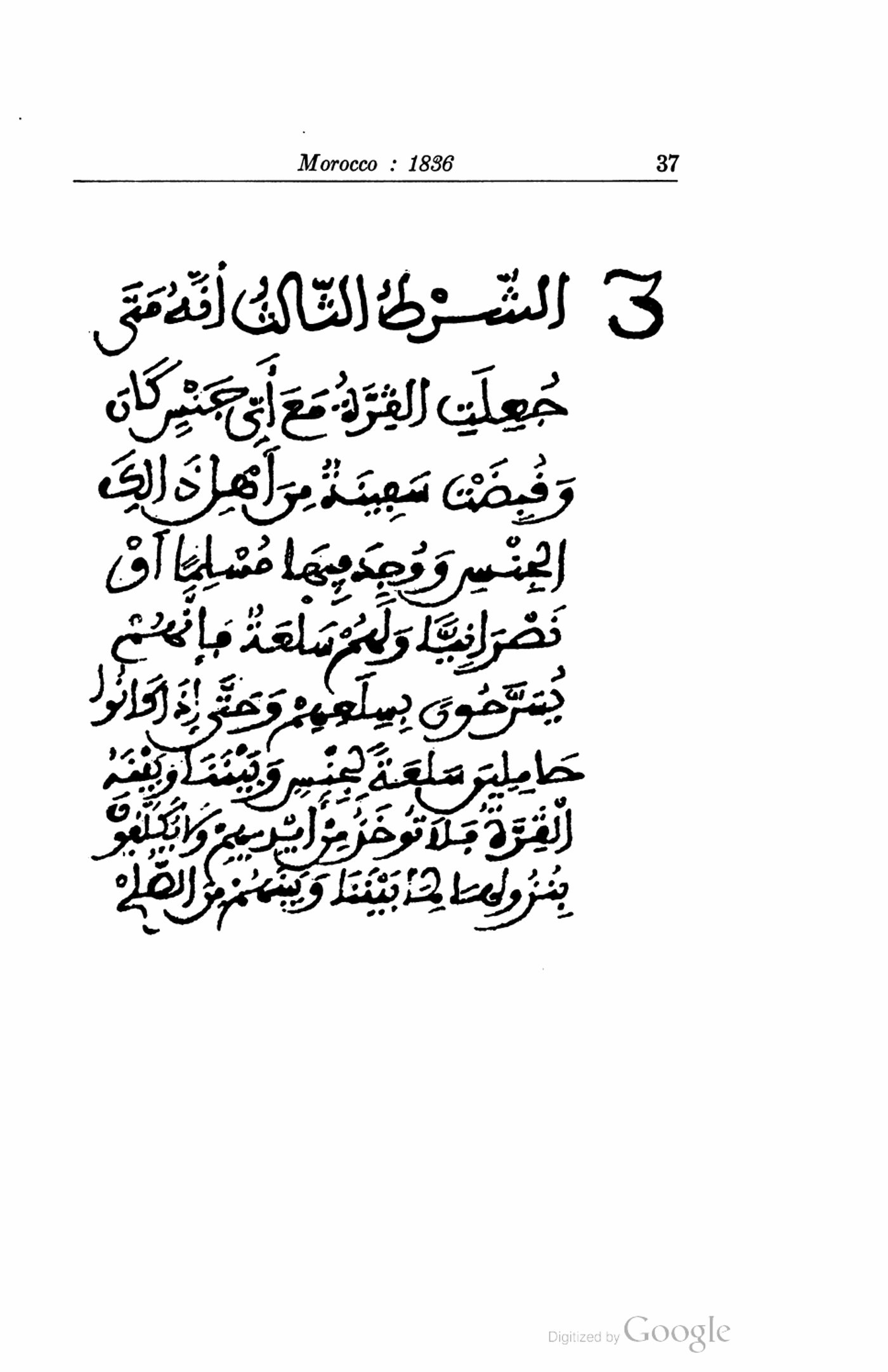
الشرط الثالث — أنه متى كانت الحرب مع أي جنس، وقُبضت سفينة من ذلك الجنس، ووُجد فيها مسلمًا أو نصرانيًّا، ولهم سلعة، فإنهم يُسَرَّحون بسلعهم؛ وحتى إذا كانوا حاملين سلعةً لجنس بيننا وبينه [حربٌ][O]، [حال تُحمَل][O] في سفينة [الآخر][O]، تمرُّ سالمةً [غير مَغشومة][O]، من غير أن يُتعرَّض لها بأخذها وقبضها وتوقيفها.
1836 Arabic, print 37 — read complete from the facsimile of record; [O] marks the unresolved word-forms (the 1836 text carries the 1786 sense).
The 1836 recordation, Article 3 (Miller, vol. 4, print 37).
Verify: Miller vol. 4, print 37 · DOR-AF, PDF = print − 183.
Word by word — the doctrine-bearing units
Arabic
Transliteration
Gloss and carried English
Flag
يُسَرَّحون
yusarraḥūn
“they are released / set at liberty” — carried “set at Liberty”
[W]
تَمُرُّ سَالِمَةً
tamurru sālimatan
“passes safe and unharmed” — carried “pass free and unmolested”
[W]
بِأَخْذِهَا وَقَبْضِهَا وَتَوْقِيفِهَا
bi-akhdhihā wa-qabḍihā wa-tawqīfihā
“by taking it, seizing it, and detaining it” — the detention triad, all barred; carried “to take or detain them”
[W]
جِنْس
jins
“a nation / a kind” — the article’s word for a foreign nation
[S]
سَلِعَة
saliʿa
“goods / merchandise”
[S]
Article 4 of 25
The ʿalāma — the signal by which they are known
“A Signal or Pass shall be given to all Vessels belonging to both Parties, by which they are to be known when they meet at Sea, and if the Commander of a Ship of War of either Party shall have other Ships under his Convoy, the Declaration of the Commander shall alone be sufficient to exempt any of them from examination.”
— The 1786 carried English of record (8 Stat. 100 tradition; translator of record Issac Cardoza Nuñez, per Barclay’s certificate).
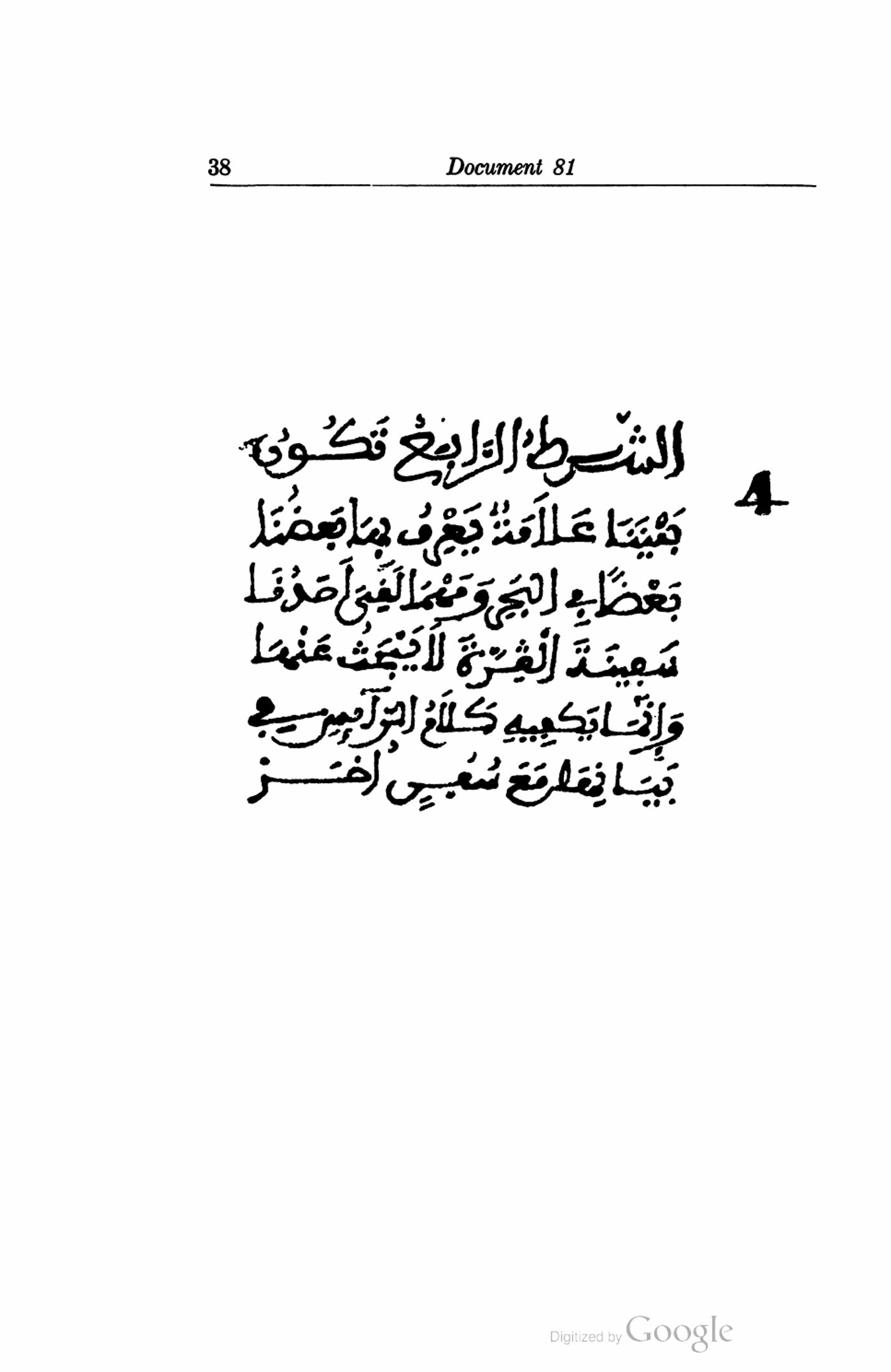
الشرط الرابع — … بيننا علامة يُعرف بها بعضنا بعضًا …
The ʿalāma verse of record (1836 Arabic, print 38; the 1786 sealed book at Miller, vol. 2). The mark of recognition this site itself carries in its banner: عَلَامَة بَيْنَنَا نَعْرِفُ بِهَا — “a mark between us by which we know.”
The 1836 recordation, Article 4 — the ʿalāma (Miller, vol. 4, print 38).
Verify: Miller vol. 4, print 38 · DOR-AF.
Word by word — the doctrine-bearing units
Arabic
Transliteration
Gloss and carried English
Flag
عَلَامَة
ʿalāma
“a mark / signal” — the mark of recognition; carried “A Signal or Pass”
[W]
يُعْرَفُ بِهَا
yuʿrafu bihā
“by which they are known” — recognition, not permission
[W]
بَعْضُنَا بَعْضًا
baʿḍunā baʿḍan
“one another” — mutual recognition between the parties
[S]
The ʿalāma is the treaty’s own **recognition instrument**: a mark given so the parties are *known* when they meet — the self-authentication of the record. The instruments of the North Gate carry it for the same function (Charter, Clause VI: the protective lines must not be struck). **SUMMARY — the full rule with its evidences: ḤIBAH ch. 16 · CORPUS line 61 · studied in Module IV.**
Article 5 of 25
Examination at sea — two or three men only
“If either of the Parties shall be at War, and shall meet a Vessel at Sea, belonging to the other, it is agreed that if an examination is to be made, it shall be done by sending a Boat with two or three Men only, and if any Gun shall be Bred and injury done without Reason, the offending Party shall make good all damages.”
— The 1786 carried English of record (8 Stat. 100 tradition; translator of record Issac Cardoza Nuñez, per Barclay’s certificate).
The Arabic interlinear for this article is in course of transcription from the facsimiles of record — the 1836 reproduction (Miller, vol. 4, prints 34–59) and the 1786 sealed book (Miller, vol. 2, prints 186–211). Each word publishes here as it is facsimile-verified; nothing is printed ahead of the record. The carried English of record stands above.
Article 6 of 25
Under His Majesty's protection — the amān
“If any Moor shall bring Citizens of the United States or their Effects to His Majesty, the Citizens shall immediately be set at Liberty and the Effects restored, and in like Manner, if any Moor not a Subject of these Dominions shall make Prize of any of the Citizens of America or their Effects and bring them into any of the Ports of His Majesty, they shall be immediately released, as they will then be considered as under His Majesty's Protection.”
— The 1786 carried English of record (8 Stat. 100 tradition; translator of record Issac Cardoza Nuñez, per Barclay’s certificate).
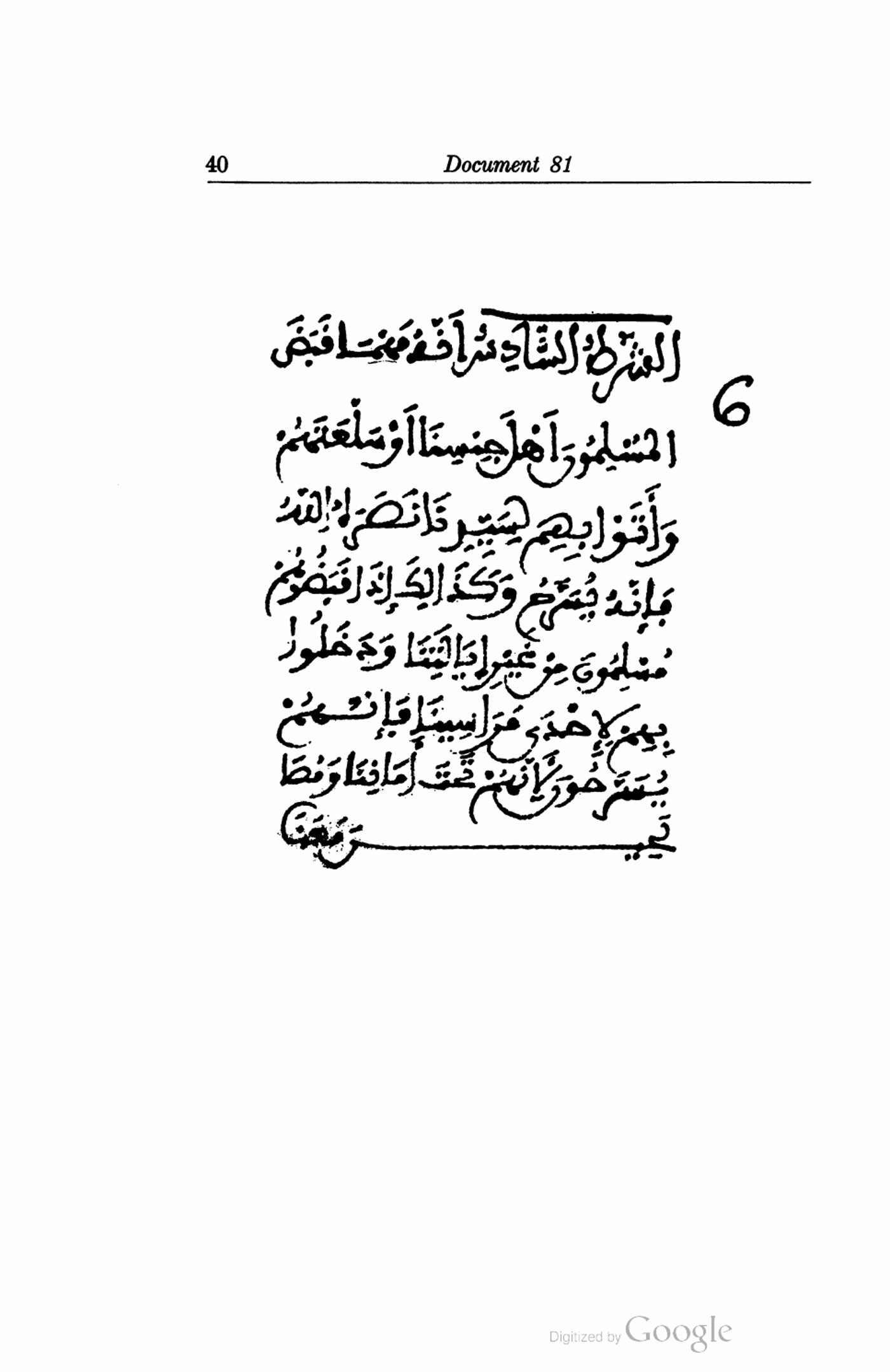
الشرط السادس — أنه متى اقتاد[O] المسلمون أهل أمريكا أو سلعتهم، فإنهم في الحال يُسَرَّحون [وتُرَدُّ سلعتهم][O]؛ وكذلك إن أسر[O] مسلمون من غير بلادنا [رعايانا] … ودخلوا بهم إحدى مراسينا، فإنهم يُسَرَّحون لأنهم إذ ذاك تحت أماننا.
1836 Arabic, print 40 — read complete from the facsimile of record; [O] marks the unresolved word-forms.
The 1836 recordation, Article 6 (Miller, vol. 4, print 40).
Verify: Miller vol. 4, print 40 · DOR-AF.
Word by word — the doctrine-bearing units
Arabic
Transliteration
Gloss and carried English
Flag
أَهْل أَمْرِيكَا
ahl Amrīkā
“the people of America” — carried “Citizens of the United States”; the same rendering pair as Article 24
[W]
يُسَرَّحون
yusarraḥūn
“they are released” — carried “immediately be set at Liberty / immediately released”
[W]
تَحْت أَمَانِنَا
taḥta amāninā
“under Our protection” — the amān instrument in the Emperor’s own voice; carried “under His Majesty’s Protection”
[W]
إِحْدَى مَرَاسِينَا
iḥdā marāsīnā
“one of Our ports (anchorages)” — carried “any of the Ports of His Majesty”
[S]
Amān is the period’s **protection instrument**: the guest under the sovereign’s amān is inviolable — released “in the state” (فِي الْحَال, immediately) because protection has already attached. **SUMMARY — the full rule with its evidences: the volumes of record (Companion-I, the gateway framework).**
Article 7 of 25
Provisions and supplies in port
“If any Vessel of either Party shall put into a Port of the other and have occasion for Provisions or other Supplies, they shall be furnished without any interruption or molestation.”
— The 1786 carried English of record (8 Stat. 100 tradition; translator of record Issac Cardoza Nuñez, per Barclay’s certificate).
The Arabic interlinear for this article is in course of transcription from the facsimiles of record — the 1836 reproduction (Miller, vol. 4, prints 34–59) and the 1786 sealed book (Miller, vol. 2, prints 186–211). Each word publishes here as it is facsimile-verified; nothing is printed ahead of the record. The carried English of record stands above.
Article 8 of 25
Disaster at sea — repair without duty
“If any Vessel of the United States shall meet with a Disaster at Sea and put into one of our Ports to repair, she shall be at Liberty to land and reload her cargo, without paying any Duty whatever.”
— The 1786 carried English of record (8 Stat. 100 tradition; translator of record Issac Cardoza Nuñez, per Barclay’s certificate).
The Arabic interlinear for this article is in course of transcription from the facsimiles of record — the 1836 reproduction (Miller, vol. 4, prints 34–59) and the 1786 sealed book (Miller, vol. 2, prints 186–211). Each word publishes here as it is facsimile-verified; nothing is printed ahead of the record. The carried English of record stands above.
Article 9 of 25
Cast on shore — particularly under Our protection
“If any Vessel of the United States shall be cast on Shore on any Part of our Coasts, she shall remain at the disposition of the Owners and no one shall attempt going near her without their Approbation, as she is then considered particularly under our Protection; and if any Vessel of the United States shall be forced to put into our Ports, by Stress of weather or otherwise, she shall not be compelled to land her Cargo, but shall remain in tranquillity untill the Commander shall think proper to proceed on his Voyage.”
— The 1786 carried English of record (8 Stat. 100 tradition; translator of record Issac Cardoza Nuñez, per Barclay’s certificate).
The Arabic interlinear for this article is in course of transcription from the facsimiles of record — the 1836 reproduction (Miller, vol. 4, prints 34–59) and the 1786 sealed book (Miller, vol. 2, prints 186–211). Each word publishes here as it is facsimile-verified; nothing is printed ahead of the record. The carried English of record stands above.
Article 10 of 25
Engagement within gunshot of the forts
“If any Vessel of either of the Parties shall have an engagement with a Vessel belonging to any of the Christian Powers within gunshot of the Forts of the other, the Vessel so engaged shall be defended and protected as much as possible untill she is in safety; And if any American Vessel shall be cast on shore on the Coast of Wadnoon or any coast thereabout, the People belonging to her shall be protected, and assisted untill by the help of God, they shall be sent to their Country.”
— The 1786 carried English of record (8 Stat. 100 tradition; translator of record Issac Cardoza Nuñez, per Barclay’s certificate).
The Arabic interlinear for this article is in course of transcription from the facsimiles of record — the 1836 reproduction (Miller, vol. 4, prints 34–59) and the 1786 sealed book (Miller, vol. 2, prints 186–211). Each word publishes here as it is facsimile-verified; nothing is printed ahead of the record. The carried English of record stands above.
Article 11 of 25
Twenty-four hours before pursuit
“If we shall be at War with any Christian Power and any of our Vessels sail from the Ports of the United States, no Vessel belonging to the enemy shall follow untill twenty four hours after the Departure of our Vessels; and the same Regulation shall be observed towards the American Vessels sailing from our Ports.-be their enemies Moors or Christians.”
— The 1786 carried English of record (8 Stat. 100 tradition; translator of record Issac Cardoza Nuñez, per Barclay’s certificate).
The Arabic interlinear for this article is in course of transcription from the facsimiles of record — the 1836 reproduction (Miller, vol. 4, prints 34–59) and the 1786 sealed book (Miller, vol. 2, prints 186–211). Each word publishes here as it is facsimile-verified; nothing is printed ahead of the record. The carried English of record stands above.
Article 12 of 25
Ships of war never examined
“If any Ship of War belonging to the United States shall put into any of our Ports, she shall not be examined on any Pretence whatever, even though she should have fugitive Slaves on Board, nor shall the Governor or Commander of the Place compel them to be brought on Shore on any pretext, nor require any payment for them.”
— The 1786 carried English of record (8 Stat. 100 tradition; translator of record Issac Cardoza Nuñez, per Barclay’s certificate).
The Arabic interlinear for this article is in course of transcription from the facsimiles of record — the 1836 reproduction (Miller, vol. 4, prints 34–59) and the 1786 sealed book (Miller, vol. 2, prints 186–211). Each word publishes here as it is facsimile-verified; nothing is printed ahead of the record. The carried English of record stands above.
Article 13 of 25
The salute returned — gun for gun, not more or less
“If a Ship of War of either Party shall put into a Port of the other and salute, it shall be returned from the Fort, with an equal Number of Guns, not with more or less.”
— The 1786 carried English of record (8 Stat. 100 tradition; translator of record Issac Cardoza Nuñez, per Barclay’s certificate).
The Arabic interlinear for this article is in course of transcription from the facsimiles of record — the 1836 reproduction (Miller, vol. 4, prints 34–59) and the 1786 sealed book (Miller, vol. 2, prints 186–211). Each word publishes here as it is facsimile-verified; nothing is printed ahead of the record. The carried English of record stands above.
Article 14 of 25
Commerce on the most-favored footing
“The Commerce with the United States shall be on the same footing as is the Commerce with Spain or as that with the most favored Nation for the time being and their Citizens shall be respected and esteemed and have full Liberty to pass and repass our Country and Sea Ports whenever they please without interruption.”
— The 1786 carried English of record (8 Stat. 100 tradition; translator of record Issac Cardoza Nuñez, per Barclay’s certificate).
The Arabic interlinear for this article is in course of transcription from the facsimiles of record — the 1836 reproduction (Miller, vol. 4, prints 34–59) and the 1786 sealed book (Miller, vol. 2, prints 186–211). Each word publishes here as it is facsimile-verified; nothing is printed ahead of the record. The carried English of record stands above.
Article 15 of 25
Merchants' interpreters — customary rates, not more and not less
“Merchants of both Countries shall employ only such interpreters, & such other Persons to assist them in their Business, as they shall think proper. No Commander of a Vessel shall transport his Cargo on board another Vessel, he shall not be detained in Port, longer than he may think proper, and all persons employed in loading or unloading Goods or in any other Labor whatever, shall be paid at the Customary rates, not more and not less.”
— The 1786 carried English of record (8 Stat. 100 tradition; translator of record Issac Cardoza Nuñez, per Barclay’s certificate).
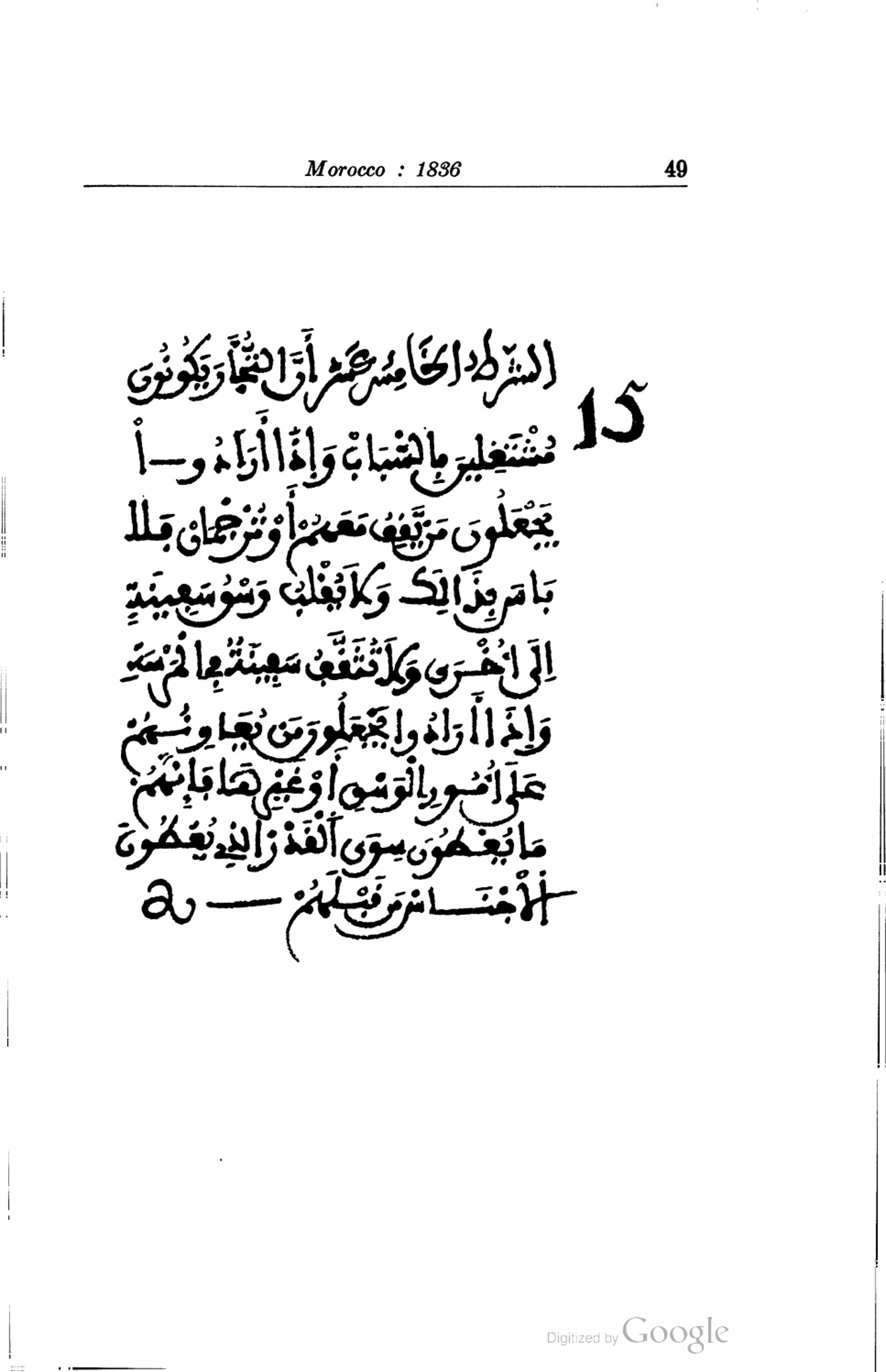
الشرط الخامس عشر — أن التجار يكونون[O] متخذين من أهل[O] ما يرتضونه ومن[O] يعينهم في أمورهم كما يرتضونه؛ ولا يُنقل رئيس السفينة [حمولتها] إلى أخرى؛ ولا تُوقَّف سفينة في المرسى [بقدر ما يشاء][O-order]؛ وإذا أرادوا أن يجعلوا من يعاونهم على أمور [الحمل] أو غيرها فإنهم ما يُعطون سوى القدر الذي يُعطَى زِيَادَةً وَلَا نُقْصَانًا.
1836 Arabic, print 49 — read complete from the facsimile of record; [O] marks the unresolved forms (including a trailing catchword-like مَا-form).
The 1836 recordation, Article 15 (Miller, vol. 4, print 49).
Verify: Miller vol. 4, print 49 · DOR-AF.
Word by word — the doctrine-bearing units
Arabic
Transliteration
Gloss and carried English
Flag
لَا تُوقَّف سَفِينَة فِي الْمَرْسَى
lā tūqqafu safīnatun fī l-marsā
“no vessel shall be detained in the port” — the waqf detention root; carried “he shall not be detained in Port”
[W]
زِيَادَةً وَلَا نُقْصَانًا
ziyādatan wa-lā nuqṣānan
“with increase and without decrease” — carried “at the Customary rates, not more and not less”
[W]
التُّجَّار
al-tujjār
“the merchants” — the article’s subject
[S]
يَرْتَضُونه
yartaḍūnahu
“as they approve / think proper” — choice belongs to the merchant
[S]
Article 16 of 25
Prisoners exchanged, never enslaved
“In case of a War between the Parties, the Prisoners are not to be made Slaves, but to be exchanged one for another, Captain for Captain, Officer for Officer and one private Man for another; and if there shall prove a deficiency on either side, it shall be made up by the payment of one hundred Mexican Dollars for each Person wanting; And it is agreed that all Prisoners shall be exchanged in twelve Months from the Time of their being taken, and that this exchange may be effected by a Merchant or any other Person authorized by either of the Parties.”
— The 1786 carried English of record (8 Stat. 100 tradition; translator of record Issac Cardoza Nuñez, per Barclay’s certificate).
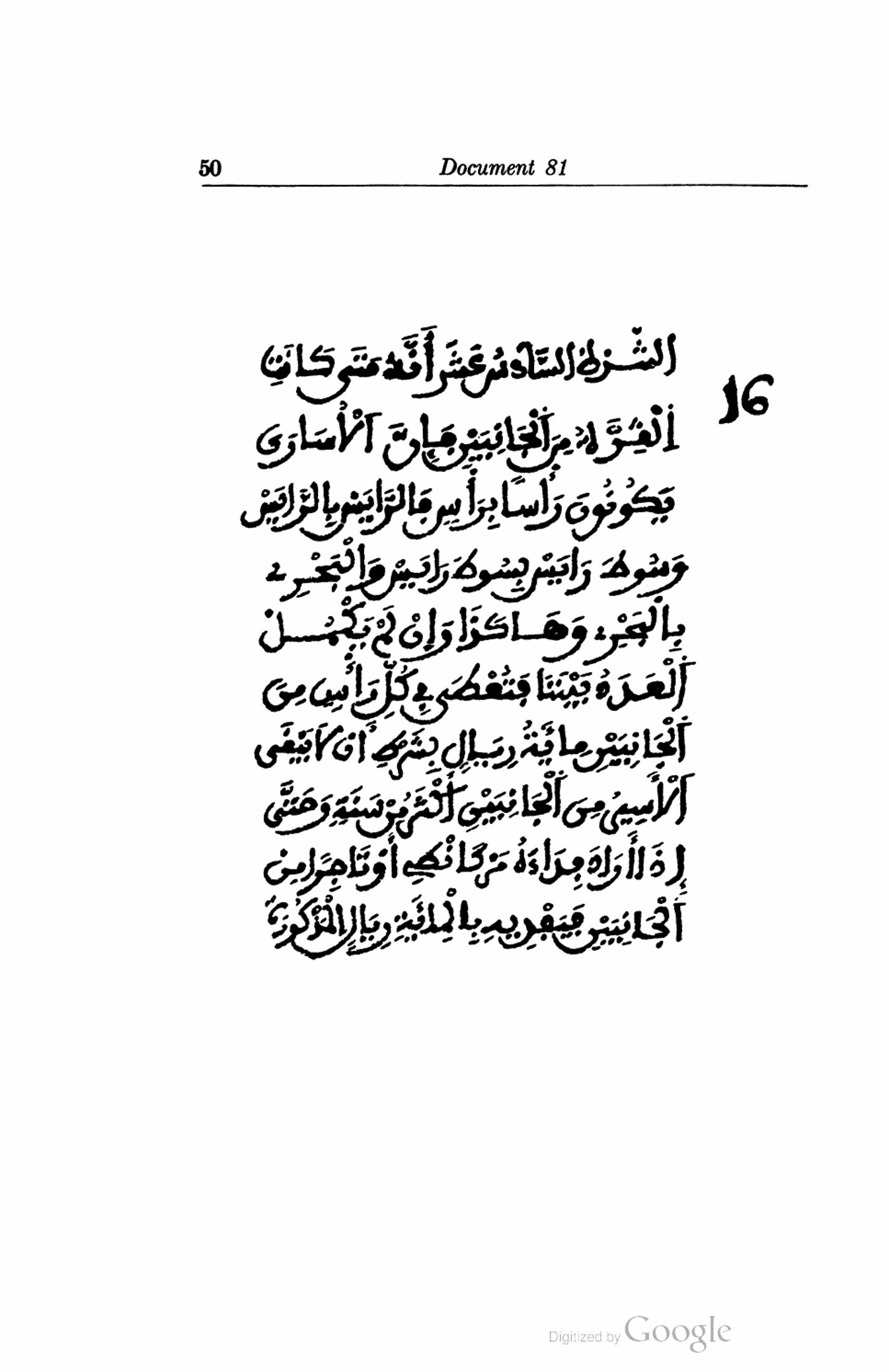
الشرط السادس عشر — أنه ما كانت [الحرب][O] بين الجانبين، فإن الأسارى يكونون رأسًا برأس: الرئيس بالرئيس، و[سُبُوهُ/دُونَ][O] رئيسٍ بـ[ـهِ] رئيسٍ، [والبحريَّة بالبحريَّة][O]. وإن لم يحصل [التعادل/العدل][O] بينهما فتُعطى كل رأس من الجانبين مائة ريال، أن يُشترى بهم[O]؛ وبشرط أن يُبادل[O] الأسرى من الجانبين في تمام سنة. وحتى إذا أراد أحدهما أو كلاهما أن يُخلِّص[O] أُسَرَاءَهُم[O]، بواسطة تاجر أو غيره موكَّلٍ من أحد الجانبين[O].
1836 Arabic, print 50 — read from the facsimile of record; [O] marks unresolved forms. The Arabic carries the no-enslavement rule inside the exchange formula itself — there is no separate negation clause; the carried English states it expressly (“not to be made Slaves, but to be exchanged”).
The 1836 recordation, Article 16 (Miller, vol. 4, print 50).
Verify: Miller vol. 4, print 50 · DOR-AF.
Word by word — the doctrine-bearing units
Arabic
Transliteration
Gloss and carried English
Flag
الأَسَارَى
al-asārā
“the captives / prisoners” — the article’s word; carried “the Prisoners”
[W]
رَأْسًا بِرَأْس
raʾsan bi-raʾs
“head for head” — one-for-one exchange; carried “exchanged one for another”
[W]
الرَّئِيس بِالرَّئِيس
al-raʾīsu bi-l-raʾīs
“the captain for the captain” — rank-for-rank parity; carried “Captain for Captain”
[S]
مِائَة رِيَال
miʾatu riyāl
“one hundred dollars” — the deficiency price per head; carried “one hundred Mexican Dollars for each Person wanting”
[S]
تَمَام سَنَة
tamāmu sanah
“a full year” — the exchange window; carried “in twelve Months from the Time of their being taken”
[S]
تَاجِر … مُوَكَّل
tājir … muwakkal
“a merchant … an authorized agent” — the exchange may be effected by private mandate; carried “a Merchant or any other Person authorized”
[O]
Captivity here is **administrative, never proprietary**: the article’s whole machinery is exchange and price (رَأْسًا بِرَأْس … مِائَة رِيَال), with a one-year outer limit and a private-mandate path home. Contrast the word this treaty never uses for the guest: no ownership vocabulary attaches to أَهْل أَمْرِيكَا. **SUMMARY — the full rule with its evidences: the volumes of record.**
Article 17 of 25
No compulsion to buy or sell
“Merchants shall not be compelled to buy or Sell any kind of Goods but such as they shall think proper; and may buy and sell all sorts of Merchandise but such as are prohibited to the other Christian Nations.”
— The 1786 carried English of record (8 Stat. 100 tradition; translator of record Issac Cardoza Nuñez, per Barclay’s certificate).
The Arabic interlinear for this article is in course of transcription from the facsimiles of record — the 1836 reproduction (Miller, vol. 4, prints 34–59) and the 1786 sealed book (Miller, vol. 2, prints 186–211). Each word publishes here as it is facsimile-verified; nothing is printed ahead of the record. The carried English of record stands above.
Article 18 of 25
Goods weighed before loading — no second examination
“All goods shall be weighed and examined before they are sent on board, and to avoid all detention of Vessels, no examination shall afterwards be made, unless it shall first be proved, that contraband Goods have been sent on board, in which Case the Persons who took the contraband Goods on board shall be punished according to the Usage and Custom of the Country and no other Person whatever shall be injured, nor shall the Ship or Cargo incur any Penalty or damage whatever.”
— The 1786 carried English of record (8 Stat. 100 tradition; translator of record Issac Cardoza Nuñez, per Barclay’s certificate).
The Arabic interlinear for this article is in course of transcription from the facsimiles of record — the 1836 reproduction (Miller, vol. 4, prints 34–59) and the 1786 sealed book (Miller, vol. 2, prints 186–211). Each word publishes here as it is facsimile-verified; nothing is printed ahead of the record. The carried English of record stands above.
Article 19 of 25
No detention in port — no forced loading
“No vessel shall be detained in Port on any presence whatever, nor be obliged to take on board any Article without the consent of the Commander, who shall be at full Liberty to agree for the Freight of any Goods he takes on board.”
— The 1786 carried English of record (8 Stat. 100 tradition; translator of record Issac Cardoza Nuñez, per Barclay’s certificate).
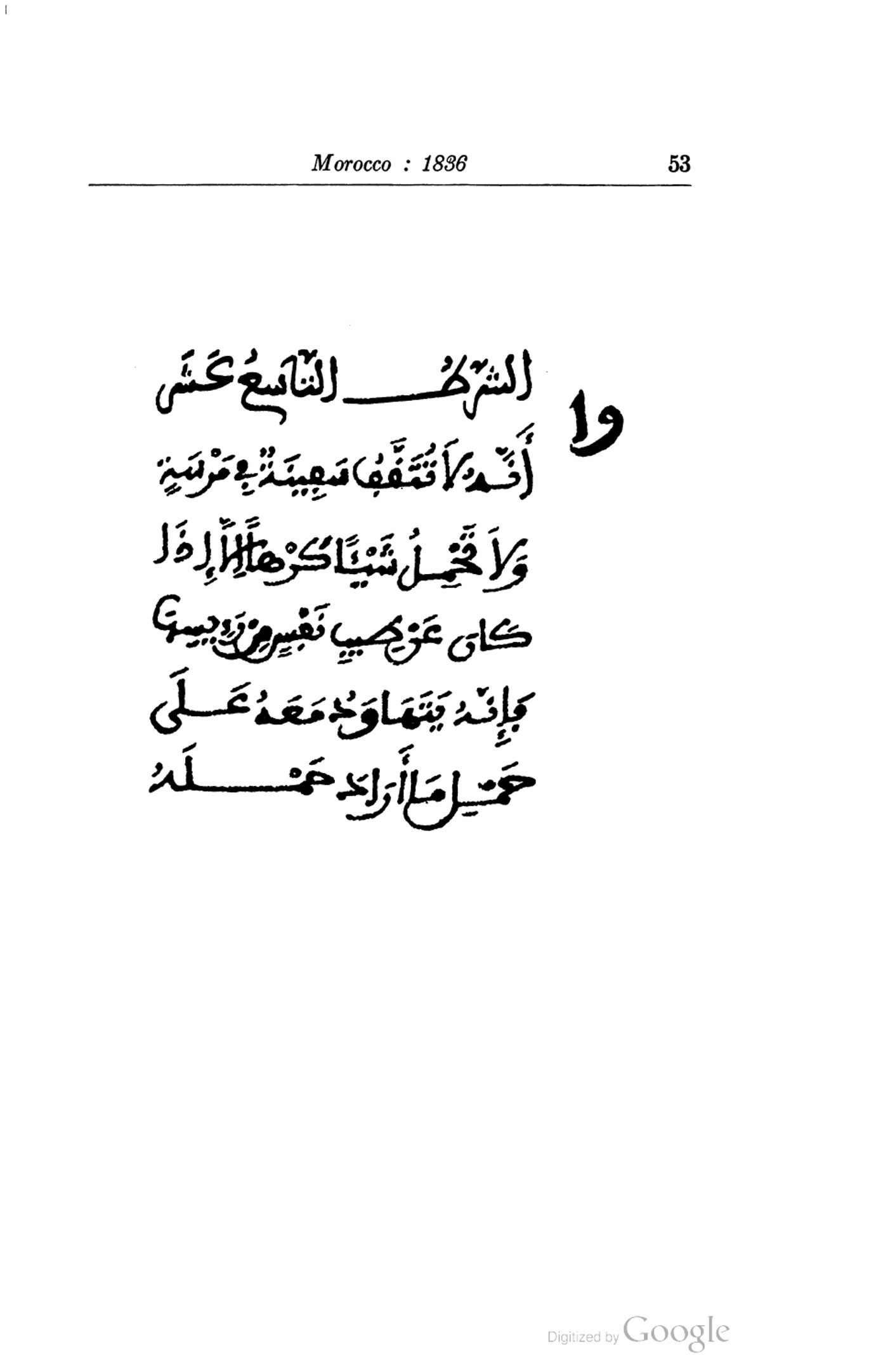
الشرط التاسع عشر — أنه لا تُوقَّف سفينة في مرسى [أبدًا][O-position]، ولا تُحمَّل شيئًا كرهًا، [كان على طيب نفس ربِّها / ترضية ربِّها][O]؛ فإنه [يتفاوض/يتهاون][O] معه على حمل ما أراد حمله.
1836 Arabic, print 53 — read from the facsimile of record; the two bars are solid; the consent/freight clause wording stands [O] (hypotheses of record).
The 1836 recordation, Article 19 (Miller, vol. 4, print 53).
Verify: Miller vol. 4, print 53 · DOR-AF.
Word by word — the doctrine-bearing units
Arabic
Transliteration
Gloss and carried English
Flag
لَا تُوقَّف سَفِينَة فِي مَرْسَى
lā tūqqafu safīnatun fī marsan
“no vessel shall be detained in a port” — the absolute form of the bar; carried “No vessel shall be detained in Port on any pretence whatever”
[W]
لَا تُحَمَّل شَيْئًا كُرْهًا
lā tuḥammalu shayʾan kurhan
“she shall not be loaded with anything against his will” — no forced loading; carried “nor be obliged to take on board any Article without the consent of the Commander”
[W]
حَمْل مَا أَرَادَ حَمْلَه
ḥamlu mā arāda ḥamlahu
“the carriage of what he wills to carry” — the freight is the commander’s own agreement
[S]
The office-function cluster
The Consular Corridor — Articles 20 → 21 → 22
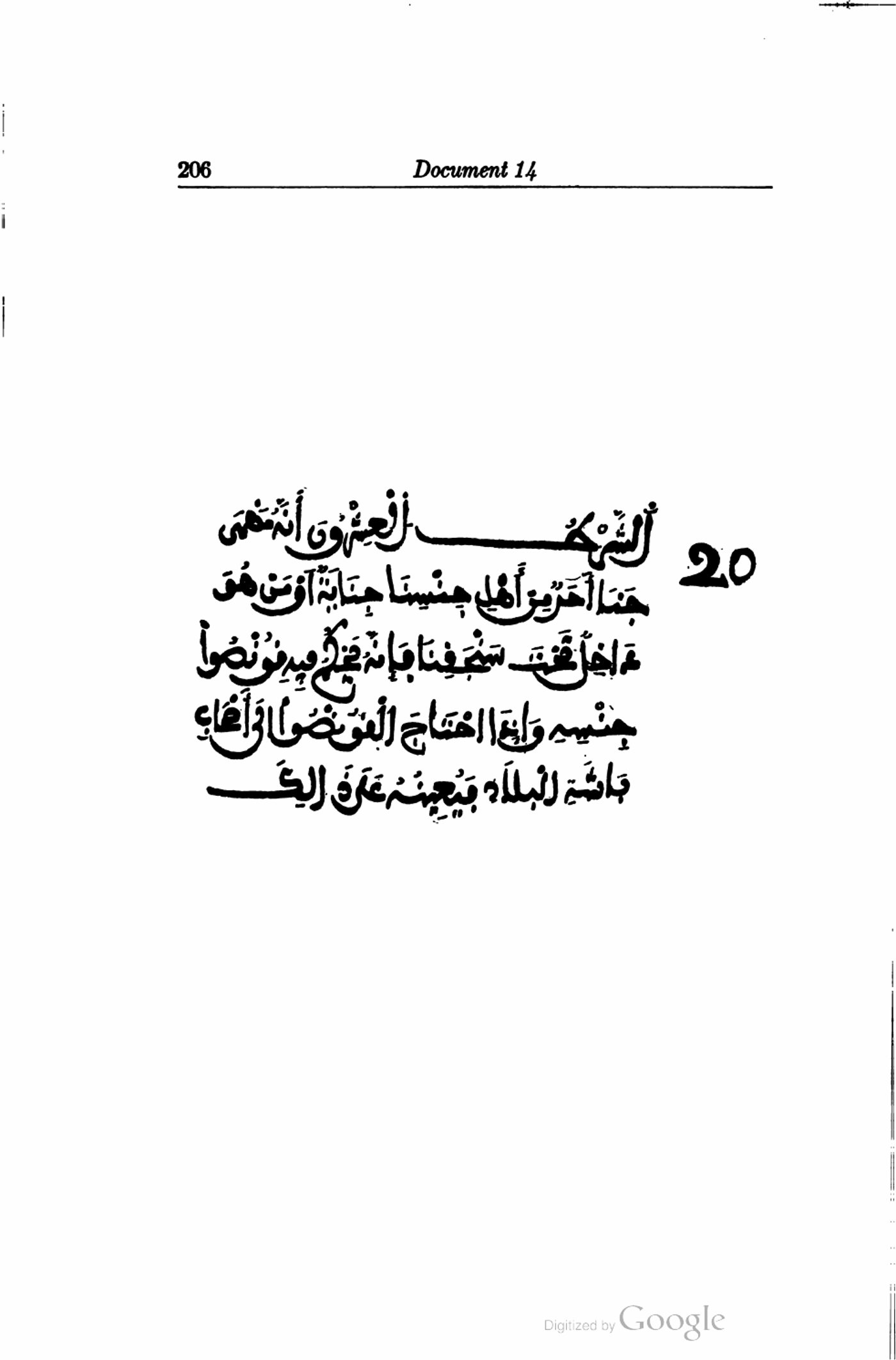
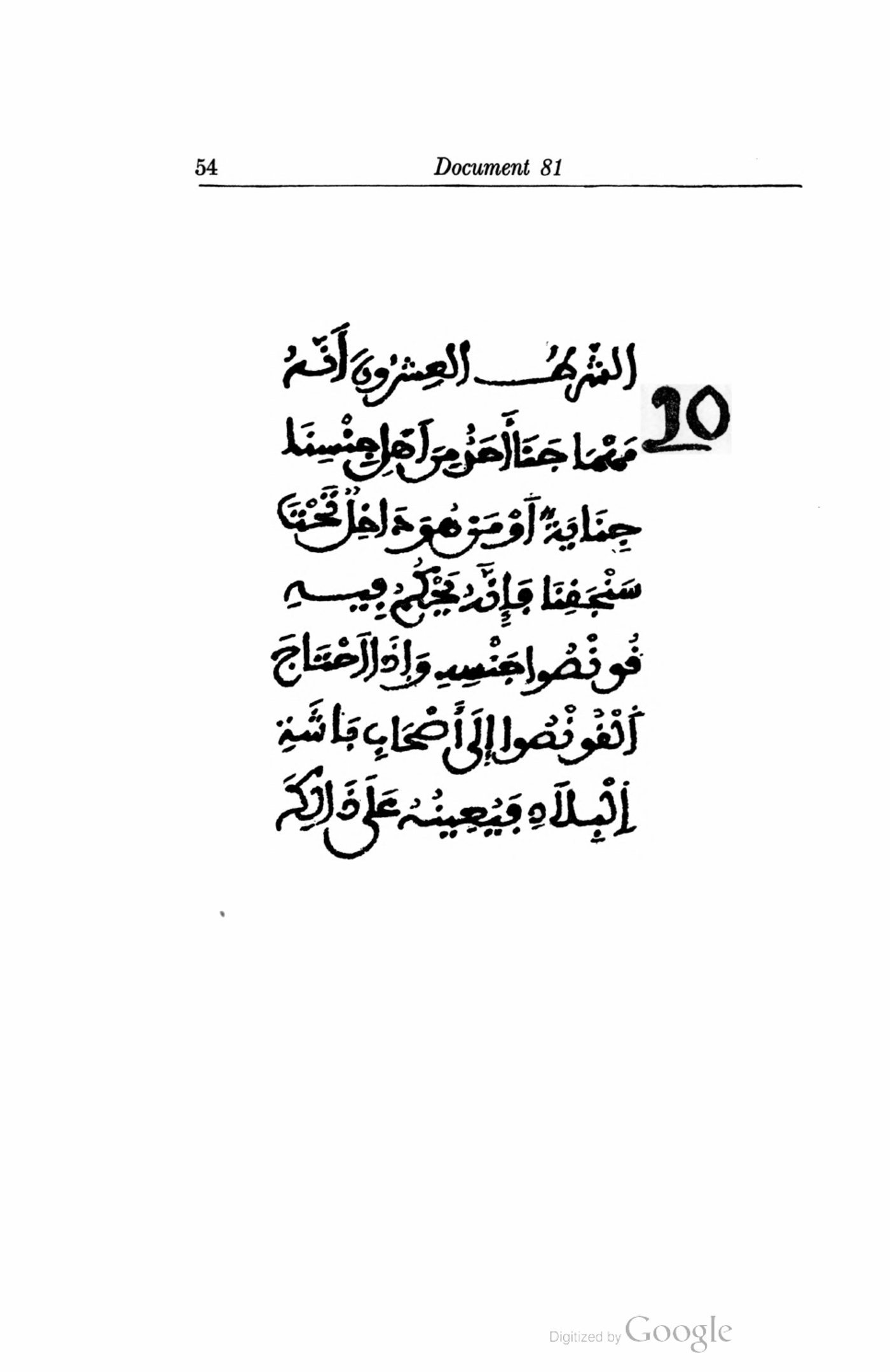
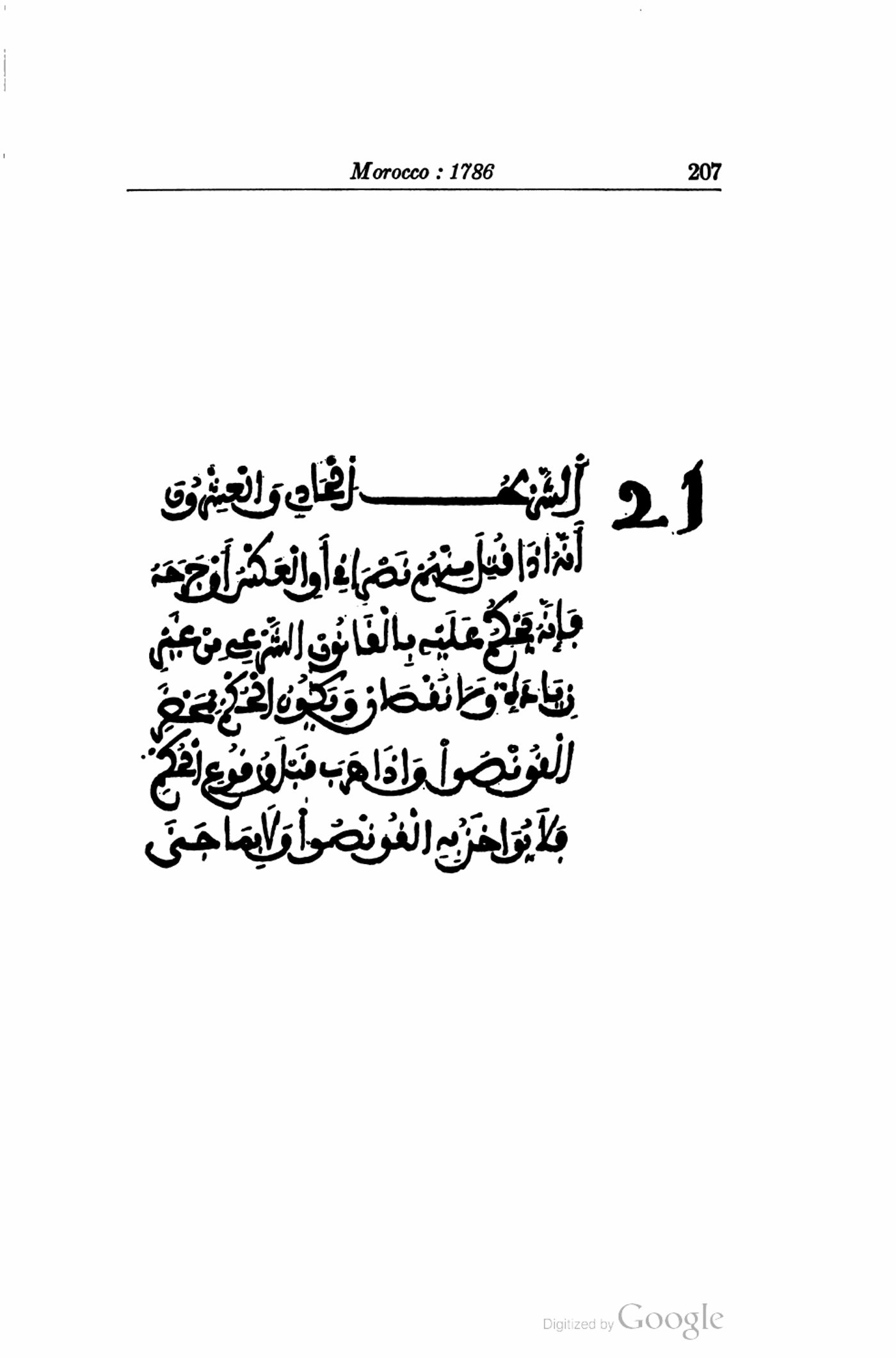
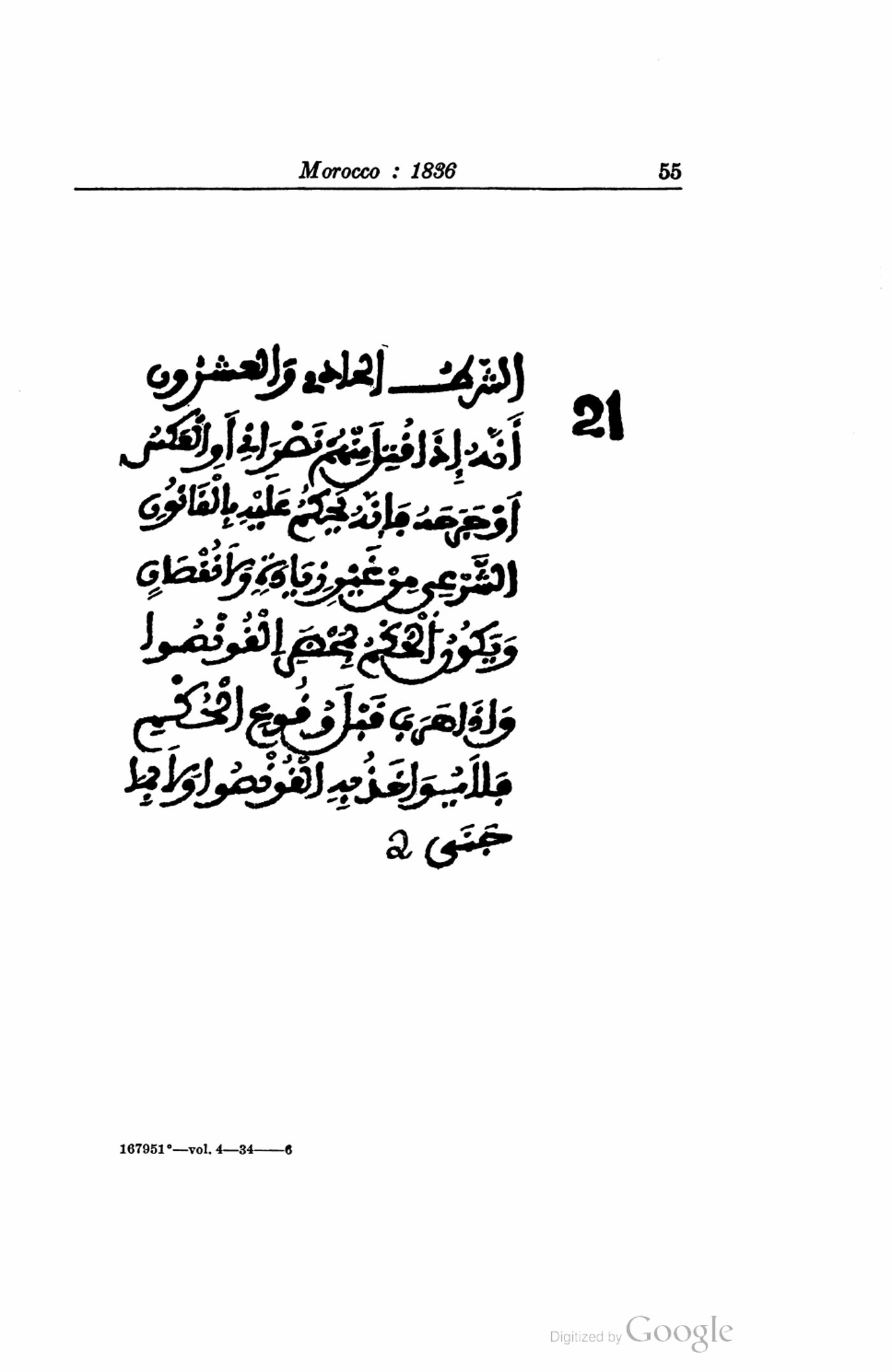
Three consecutive articles seat the treaty’s entire venue architecture in the office, and they read as one corridor. Article 20 leads: the consul decides the guests’ internal disputes — and the assistance clause makes the machinery move, aid “immediately granted” (بِلَا إِمْهَال, without delay): the honorary debt of record, the clause that moves (Companion-J). Article 21 carries the mixed wrong to judgment بِالشَّرْعِ — by the Sacred Law, without increase or decrease, in the presence of the office: the tribunal’s own charter, this site’s namesake. Article 22 closes the corridor: the office — or whoever stands in its place — holds the decedent’s estate in trust until the rightful claimant appears.
The corridor is judicially confirmed: the 1952 judgment, while ending the borrowed capitulatory layer, expressly spared “the special rights under Articles 20 and 21” — the corridor’s first two spans. Walk the corridor word by word below — Article 20 at print 206, Article 21 at print 207, Article 22 at print 208, one folio-page each, in sequence, as the scribe wrote them — then see it operate as the tribunal on the Chapter 21 page.
Article 20 of 25
The Consul decides — aid immediately granted (the honorary debt)
“If any of the Citizens of the United States, or any Persons under their Protection, shall have any disputes with each other, the Consul shall decide between the Parties and whenever the Consul shall require any Aid or Assistance from our Government to enforce his decisions it shall be immediately granted to him.”
— The 1786 carried English of record (8 Stat. 100 tradition; translator of record Issac Cardoza Nuñez, per Barclay’s certificate).
… يَفْصِلُ بَيْنَ الفِرِيقَيْن … ومتى طلب القنصل من حكومتنا معونة … تُعطى له بلا إمهال
The office-function spans of record (the 1786 sealed book, Miller, vol. 2, print 206 — plate-verified 2026-09-12; carried in 1836 (print 54)): “the Consul shall decide between the parties … it shall be immediately granted to him.”
The 1786 sealed book, Article 20 — the assistance clause (Miller, vol. 2, print 206; DOR-AF PDF 23).The 1836 recordation, Article 20 (Miller, vol. 4, print 54).
Verify: DOR-AF PDF 23 (= print 206) · Miller vol. 4, print 54 (= physical 81). The corridor’s lead span.
Word by word — the doctrine-bearing units
Arabic
Transliteration
Gloss and carried English
Flag
يَفْصِلُ بَيْنَ الفِرِيقَيْن
yafṣilu bayna al-farīqayn
“he decides between the two parties” — the consular venue for the guests’ internal disputes; carried “the Consul shall decide between the Parties”
[W]
بِلَا إِمْهَال
bilā imhāl
“without delay” — the machinery clause: aid granted on requirement, immediately; carried “it shall be immediately granted to him”
[S]
The assistance clause is the series’ **honorary debt**: aid owed as a debtor owes a sum — performance of a term the grantee wrote, not charity it may extend or withhold. **SUMMARY — the full rule with its evidences: Companion-J, ch. 2; the debt-of-honor research note of record (2026-09-11).**
Article 21 of 25
Judgment by the Sacred Law, in the presence of the office
“If a Citizen of the United States should kill or wound a Moor, or on the contrary if a Moor shall kill or wound a Citizen of the United States, the Law of the Country shall take place and equal Justice shall be rendered, the Consul assisting at the Tryal, and if any Delinquent shall make his escape, the Consul shall not be answerable for him in any manner whatever.”
— The 1786 carried English of record (8 Stat. 100 tradition; translator of record Issac Cardoza Nuñez, per Barclay’s certificate).
اذا قتل احد من الرعايا الامريكان مغربي او جرحه او بالعكس … فانه يحكم عليه بالشرع من غير زيادة ولا نقصان ويكون الحكم بحضور القنصل
The judgment span of record (the 1786 sealed book; Miller, vol. 2, print 207 — plate-verified 2026-09-12). The 1836 Arabic makes the sharʿī character explicit: بِالْقَانُونِ الشَّرْعِي — “by the sacred-law code.”
The 1786 sealed book, Article 21 — judgment by the Sacred Law (Miller, vol. 2, print 207; DOR-AF PDF 24).The 1836 recordation, Article 21 (Miller, vol. 4, print 55) — بِالْقَانُونِ الشَّرْعِي on the face of the page.
Verify: DOR-AF PDF 24 (= print 207) · Miller vol. 4, print 55 (= physical 82).
Word by word — the doctrine-bearing units
Arabic
Transliteration
Gloss and carried English
Flag
الرَّعَايَا الْأَمْرِيكَان
al-raʿāyā al-Amrīkān
“the American subjects” — the guest subjects; carried “a Citizen of the United States” (contrast Art. 24’s raʿāyā → “Subjects”)
[S]
يُحْكَمُ عَلَيْهِ بِالشَّرْعِ
yuḥkamu ʿalayhi bi-l-sharʿ
“judgment is upon him by the Sacred Law” — the Muhammadan Sharia of the Empire; carried (misrendered) “the Law of the Country shall take place”
[W]
مِنْ غَيْرِ زِيَادَةٍ وَلَا نَقْصَان
min ghayri ziyādatin wa-lā naqṣān
“without increase or decrease” — exact justice, nothing added, nothing taken; carried “equal Justice shall be rendered”
[W]
وَيَكُونُ الْحُكْمُ بِحُضُورِ الْقُنْصُل
wa-yakūnu al-ḥukmu bi-ḥuḍūri al-qunṣul
“and the judgment shall be in the presence of the consul” — the office present; carried “the Consul assisting at the Tryal”
[W]
**Misrendering of record — the Arabic governs the sense.** Where the carried English reads “the Law of the Country,” the 1786 Arabic reads بِالشَّرْعِ — by the Sacred Law — and the 1836 Arabic makes it explicit: بِالْقَانُونِ الشَّرْعِي. The article’s domain is the period *mixed* private-and-public character (a Moorish subject against a guest, or the reverse) — never the modern criminal-only reading, and never conceded to any consul. **SUMMARY — the full rule with its evidences: Errata of Record E-A21-1 / E-A21-2 · CORPUS line 61 · ḤIBAH ch. 16.**
Article 22 of 25
The decedent's estate held in trust
“If an American Citizen shall die in our Country and no Will shall appear, the Consul shall take possession of his Effects, and if there shall be no Consul, the Effects shall be deposited in the hands of some Person worthy of Trust, untill the Party shall appear who has a Right to demand them, but if the Heir to the Person deceased be present, the Property shall be delivered to him without interruption; and if a Will shall appear, the Property shall descend agreeable to that Will, as soon as the Consul shall declare the Validity thereof.”
— The 1786 carried English of record (8 Stat. 100 tradition; translator of record Issac Cardoza Nuñez, per Barclay’s certificate).
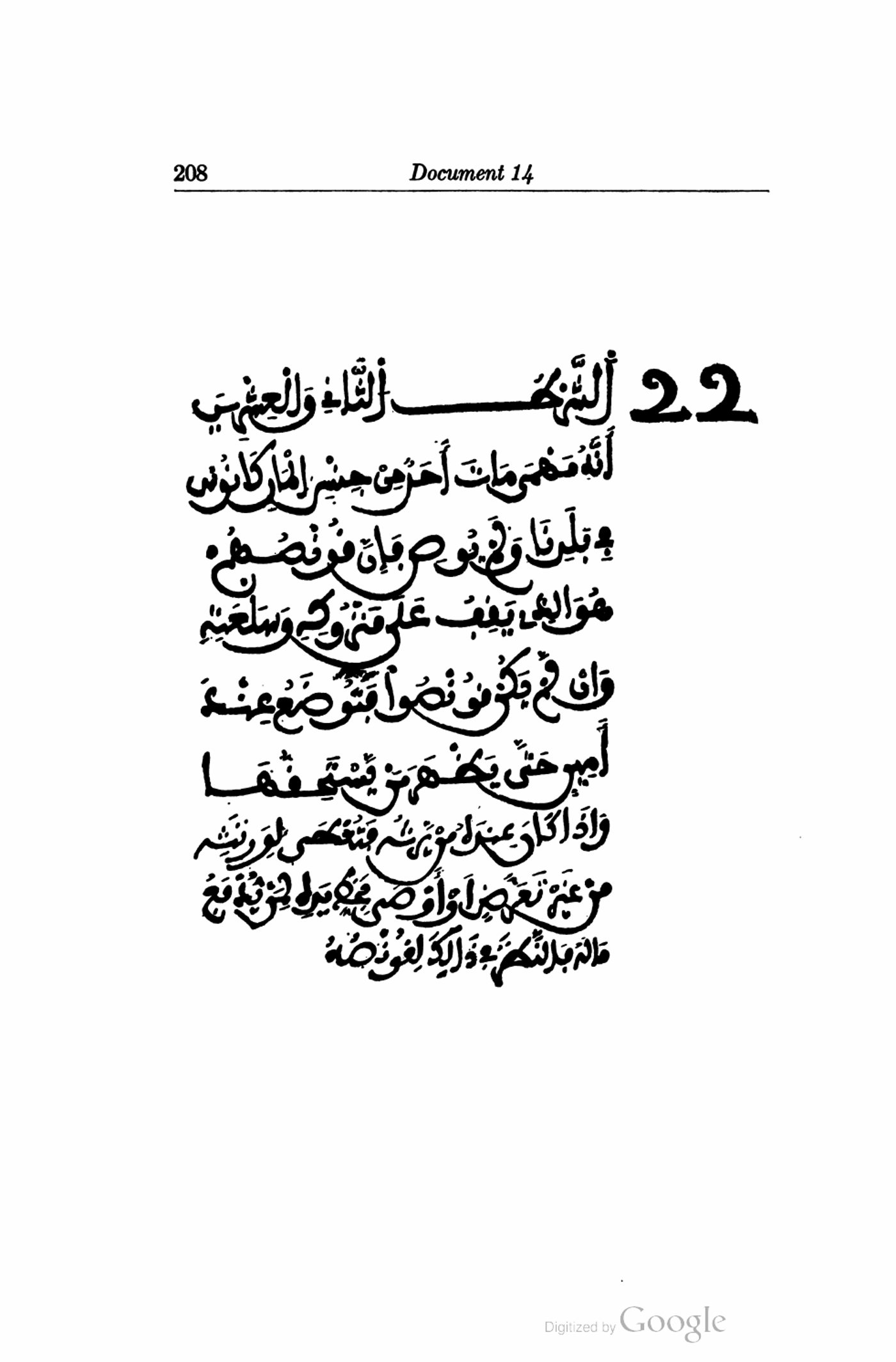
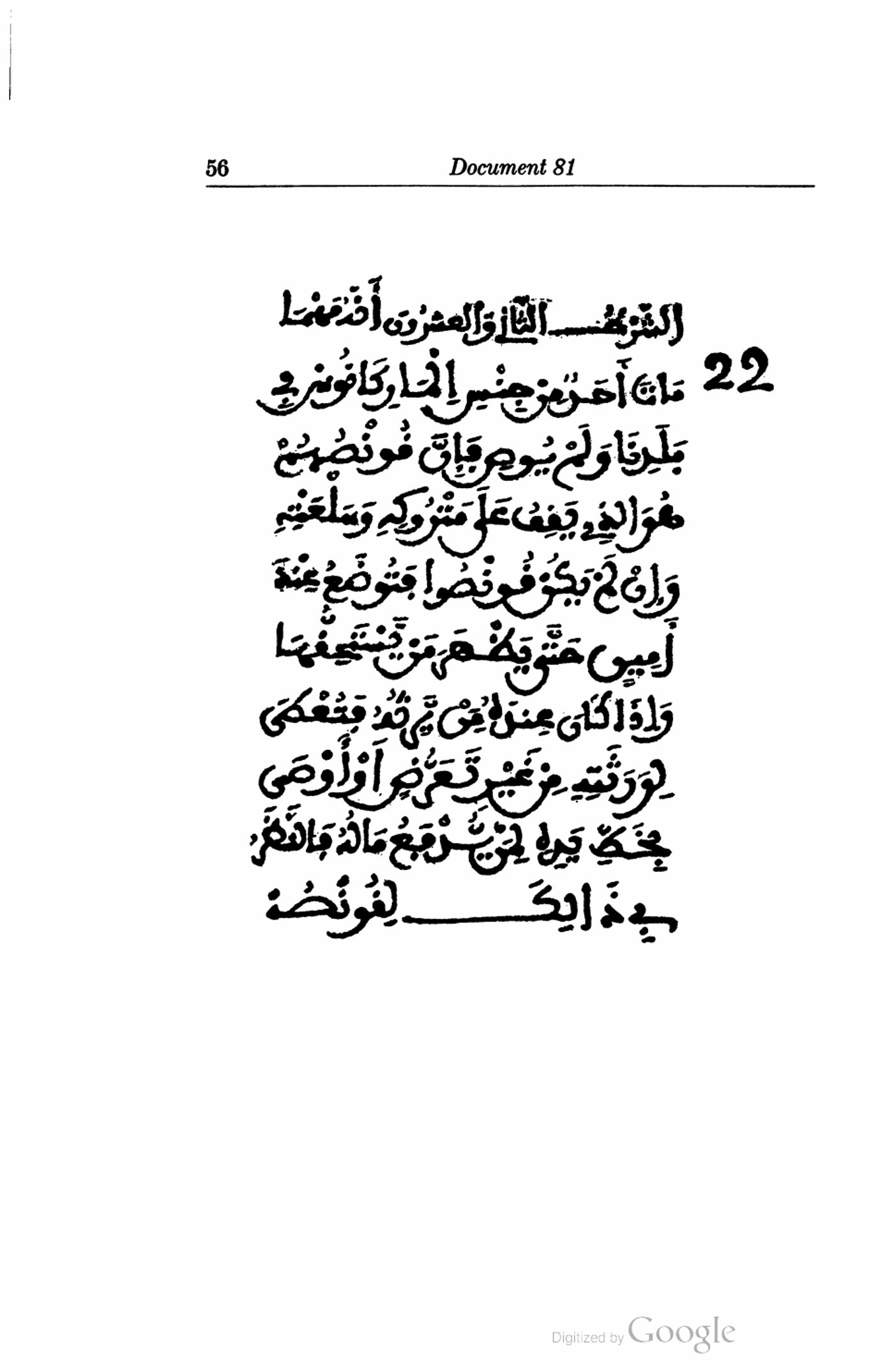
… مَنْ يَقُومُ مَقَامَهُ …
The estate-custody span of record (the 1786 sealed book, Miller, vol. 2, print 208 — plate-verified 2026-09-12): the consul, or whoever stands in his place, takes custody of the decedent’s estate for the rightful claimant.
The 1786 sealed book, Article 22 — the estate custody (Miller, vol. 2, print 208; DOR-AF PDF 25).The 1836 recordation, Article 22 (Miller, vol. 4, print 56).
Verify: DOR-AF PDF 25 (= print 208) · Miller vol. 4, print 56 (= physical 83).
Word by word — the doctrine-bearing units
Arabic
Transliteration
Gloss and carried English
Flag
مَنْ يَقُومُ مَقَامَهُ
man yaqūmu maqāmahu
“whoever stands in his place” — the succession of the office’s custody; carried “if there shall be no Consul … some Person worthy of Trust”
[W]
Article 23 of 25
Consuls' privileges — no liability without written promise
“The Consuls of the United States of America shall reside in any Sea Port of our Dominions that they shall think proper; And they shall be respected and enjoy all the Privileges which the Consuls of any other Nation enjoy, and if any of the Citizens of the United States shall contract any Debts or engagements, the Consul shall not be in any Manner accountable for them, unless he shall have given a Promise in writing for the payment or fulfilling thereof, without which promise in Writing no Application to him for any redress shall be made.”
— The 1786 carried English of record (8 Stat. 100 tradition; translator of record Issac Cardoza Nuñez, per Barclay’s certificate).
The Arabic interlinear for this article is in course of transcription from the facsimiles of record — the 1836 reproduction (Miller, vol. 4, prints 34–59) and the 1786 sealed book (Miller, vol. 2, prints 186–211). Each word publishes here as it is facsimile-verified; nothing is printed ahead of the record. The carried English of record stands above.
Article 24 of 25
The friendly application — the war bar — nine months — parity of indulgences
“If any differences shall arise by either Party infringing on any of the Articles of this Treaty, Peace and Harmony shall remain notwithstanding in the fullest force, untill a friendly Application shall be made for an Arrangement, and untill that Application shall be rejected, no appeal shall be made to Arms. And if a War shall break out between the Parties, Nine Months shall be granted to all the Subjects of both Parties, to dispose of their Effects and retire with their Property. And it is further declared that whatever indulgences in Trade or otherwise shall be granted to any of the Christian Powers, the Citizens of the United States shall be equally entitled to them.”
— The 1786 carried English of record (8 Stat. 100 tradition; translator of record Issac Cardoza Nuñez, per Barclay’s certificate).
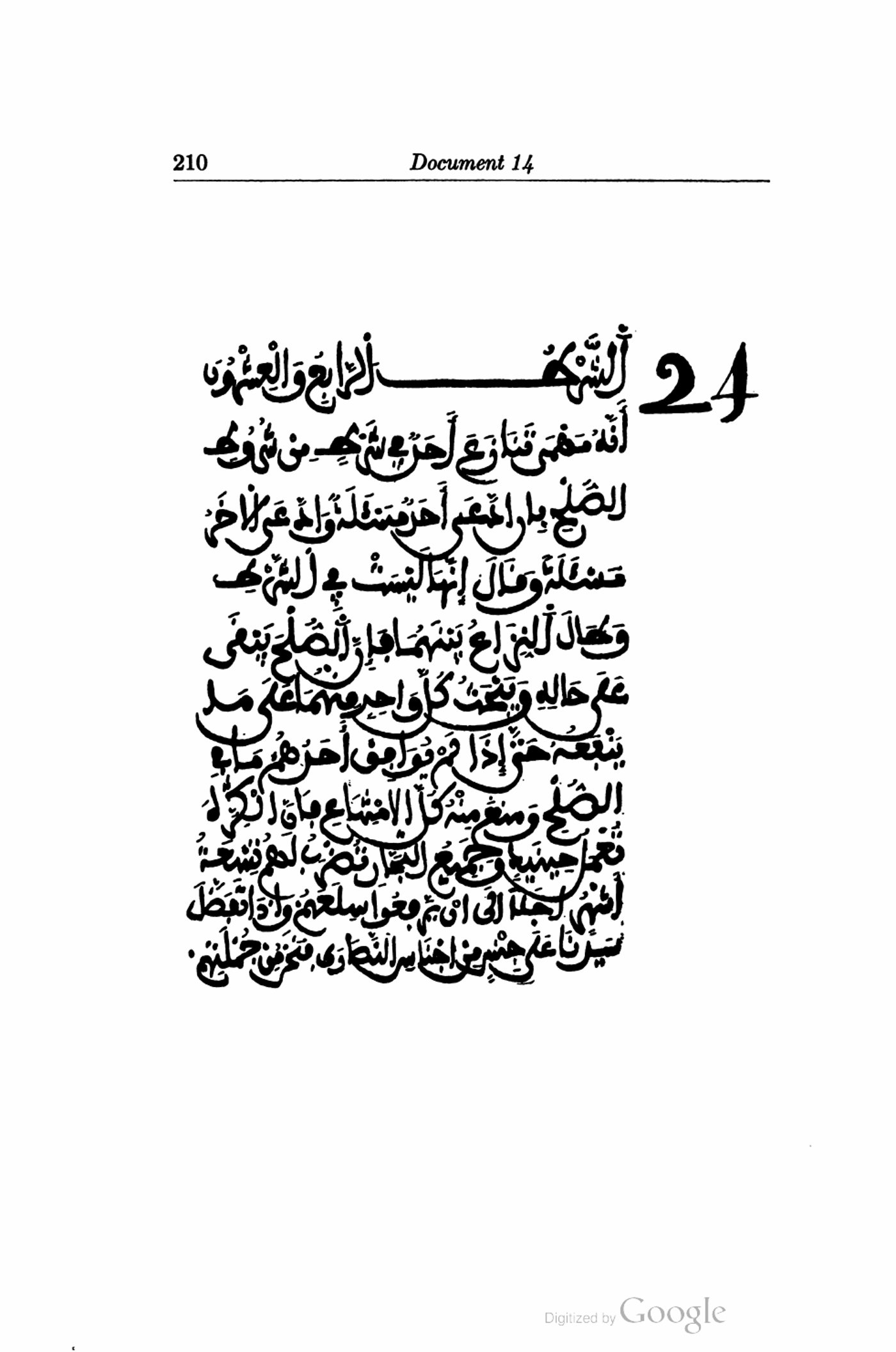
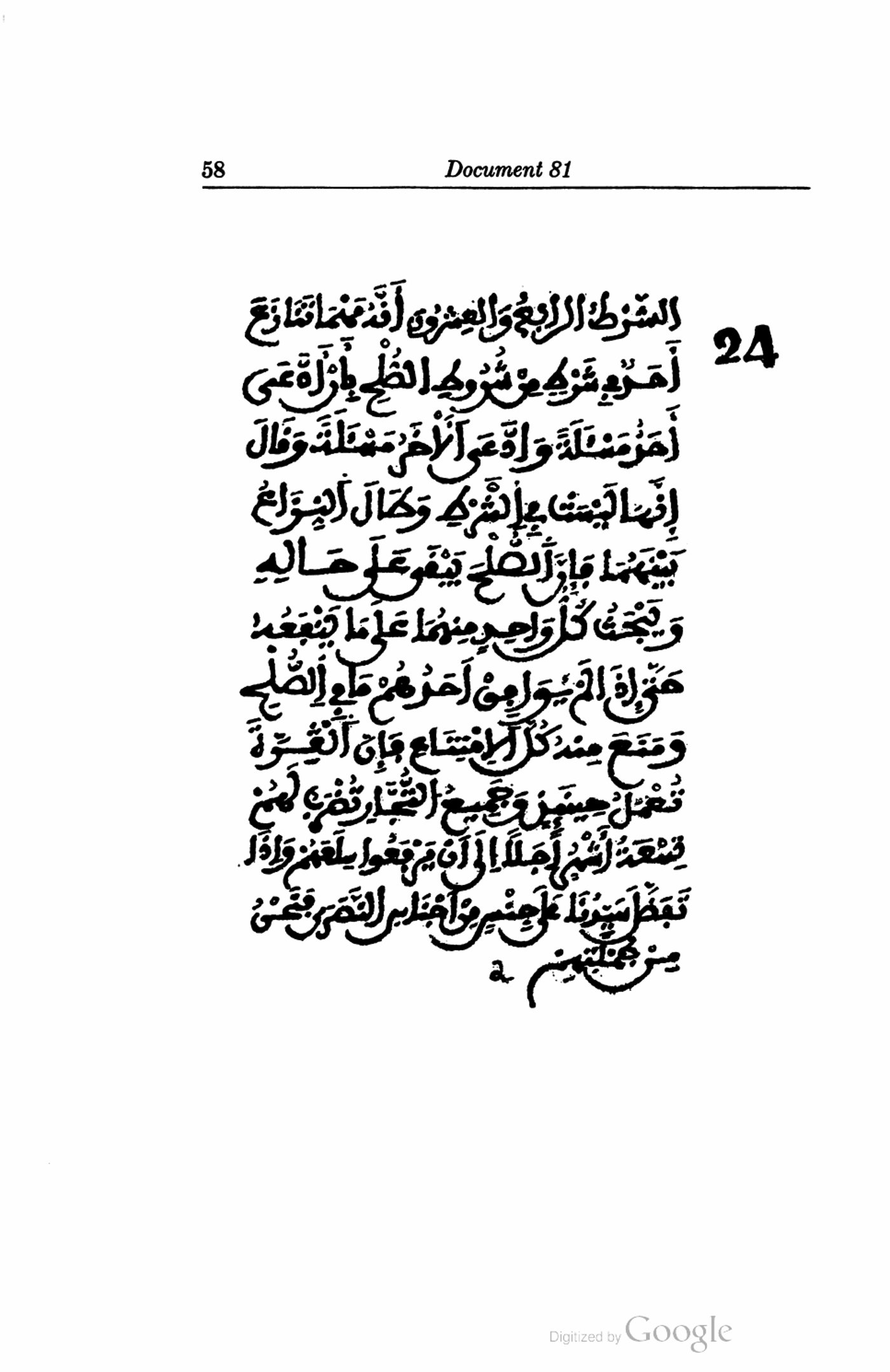
الشرط الرابع والعشرون — أنه متى تباين أحد الطرفين شيئا من شروط هذا الصلح يبقى الصلح والمودة بينهما … الى ان يطلب … يرفض … وان وقعت الحرب بينهما تسعة أشهر … الرعايا للطرفين يتصرفوا في أموالهم ويرحلوا … وأعلن أنه كل امتياز في التجارة أو غيرها يمنح … أهل أمريكا … بالسوية
The 1786 treaty-form face (witness B, folio ٢٤, print 210), phrase-anchored [W]/[S]/[O] — ellipses mark the suspended [O] regions, which assert no reading. The 1836 Arabic (print 58) carries: أنه متى نازع أحد الطرفين بأمر لزمه فيه شيء من شروط هذا الصلح يبقى الصلح والمودة بينهما على حالهما وكمالهما إلى أن يُطلب منهما على ما فيهما بالصلح … إلا أن لا يجيب إلى الصلح فلا مانع من وقوع الحرب بينهما ويُمهَل كل واحد منهما تسعة أشهر … وأعلن أن كل … في التجارة أو غيرها تعطى لأحد ممالك النصارى أعطي مثلها أهل أمريكا بالسوية (certified reading of record).
The 1786 treaty-form face, folio ٢٤ (Miller, vol. 2, print 210; DOR-AF PDF 27) — the page behind every strip and flag above.The 1836 recordation, Article 24 (Miller, vol. 4, print 58) — the certified reading of record.
Verify: DOR-AF PDF 27 (= print 210, folio ٢٤) · Miller vol. 4, print 58 (= physical 85).
The text as it runs — phrase strips (build of record, six witnesses)
Limb
Arabic (1786 face)
Sense and witnesses
Flag
The article head
الشرط الرابع والعشرون ٢٤
“The stipulation, the fourth-and-twentieth — 24” — the instrument’s own word for its clauses is sharṭ, a condition (ḤIBAH chs. 9, 19 anchor on it).
[W]
The disagreement clause
أنه متى تباين أحد الطرفين شيئا من شروط هذا الصلح
“It is that whenever one of the two parties differs as to any of the conditions of this peace.” tabāyana — reciprocal differing; the carried English adds the infringement color (“by either Party infringing”). 1836: نَازَعَ.
[W]
The peace-preservation rule
يبقى الصلح والمودة بينهما … الى ان يطلب … يرفض …
“The peace and the harmony remain between them … until application is made … is rejected.” 1836 makes the limbs explicit: على حالهما وكمالهما (“in their state and their fullness” = “in the fullest force”) … إلى أن يُطلب منهما … بالصلح (“until sought of them by way of peace”) … إلا أن لا يجيب إلى الصلح (“except if he does not answer the peace”).
[S/O]
The nine-months war contingency
وان وقعت الحرب بينهما تسعة أشهر … الرعايا للطرفين يتصرفوا في أموالهم ويرحلوا …
“And if war breaks out between them, nine months … the subjects of both parties dispose of their effects and retire …” 1836: ويُمْهَلُ — an imhāl, a respite granted.
[S]
The declared-indulgences parity clause
وأعلن أنه كل امتياز في التجارة أو غيرها يمنح … أهل أمريكا … بالسوية
“And it is declared that whatever indulgence, in trade or otherwise, is granted … the people of America … with equality.” امتياز ↔ “indulgences” (Volume D 1.0.5, CANONICAL · LOCKED). 1786 English “indulgences” plural; 1836 English “indulgence” singular — the registered collation.
[W/S/O]
Word by word — the doctrine-bearing units
Arabic
Transliteration
Gloss and carried English
Flag
شَرْط
sharṭ
“stipulation / condition” — the instrument’s own name for its clauses; the condition-discipline of the Mālikī school attaches to it
[W]
تَبَايَنَ / نَازَعَ
tabāyana / nāzaʿa
“differs / disputes” (1786 / 1836) — reciprocal differing between the parties
[W]
يَبْقَى الصُّلْح وَالْمَوَدَّة
yabqā al-ṣulḥu wa-l-mawaddah
“the peace and the harmony remain” — performance continues notwithstanding the dispute
[W]
عَلَى حَالِهِمَا وَكَمَالِهِمَا
ʿalā ḥālihimā wa-kamālihimā
“in their state and their fullness” (1836) — the Arabic of “in the fullest force”
[W]
إِلَى أَنْ يُطْلَب … بِالصُّلْح
ilā an yuṭlaba … bi-l-ṣulḥ
“until sought … by way of peace” (1836) — the friendly application, in the treaty’s own words
[W]
إِلَّا أَنْ لَا يُجِيبَ إِلَى الصُّلْح
illā an lā yujība ilā al-ṣulḥ
“except if he does not answer the peace” (1836) — the war-trigger is refusal of the peace-answer; 1786: يَرْفُض, “is rejected”
[W]
فَلَا مَانِعَ مِنْ وُقُوعِ الْحَرْبِ
fa-lā māniʿa min wuqūʿi al-ḥarb
“then no bar remains to war falling between them” (1836) — the Arabic has NO word “appeal” and NO word “arms” (سلاح) anywhere in this article
[W]
تِسْعَة أَشْهُر
tisʿatu ashhur
“nine months” — the safe-withdrawal respite (يُمْهَلُ, imhāl) even after refusal
[W]
امْتِيَاز
imtiyāz
“indulgence” — a sovereign dispensation class of lawful benefit (Volume D 1.0.5, CANONICAL · LOCKED · QA-PASSED 10/10); once in the treaty, a binding entitlement
[W]
أَهْل أَمْرِيكَا … بِالسَّوِيَّة
ahl Amrīkā … bi-l-sawiyyah
“the people of America … with equality” — parity with the Christian Powers; carried “the Citizens of the United States shall be equally entitled”
[S]
**The war bar, in the Arabic’s own architecture:** the peace and harmony remain **على حالهما وكمالهما** — in the fullest force — **إلى أن يُطلب … بالصلح** — until the matter is sought by way of peace; judgment between them is **بِإِنْصَاف** (with equity); and only **إلا أن لا يجيب إلى الصلح** — on refusal to answer the peace — does **فلا مانع من وقوع الحرب بينهما** operate. The carried English’s “no appeal shall be made to Arms” has no counterpart words in the Arabic: the war-trigger is the *refusal of the peace-answer*, not anyone’s resort to arms — and even then, **تسعة أشهر** of safe withdrawal. Disagreement is a duty to negotiate, **not** a power to end the grant; the clause carries no notice-and-termination power. **SUMMARY — the full rule with its evidences: ḤIBAH ch. 19 · CORPUS line 67 · the debt-of-honor research note of record (2026-09-11) · studied in Module II.**
Article 25 of 25
The duration clause and its adjudication
“This Treaty shall continue in full Force, with the help of God for Fifty Years.”
— The 1786 carried English of record (8 Stat. 100 tradition; translator of record Issac Cardoza Nuñez, per Barclay’s certificate).
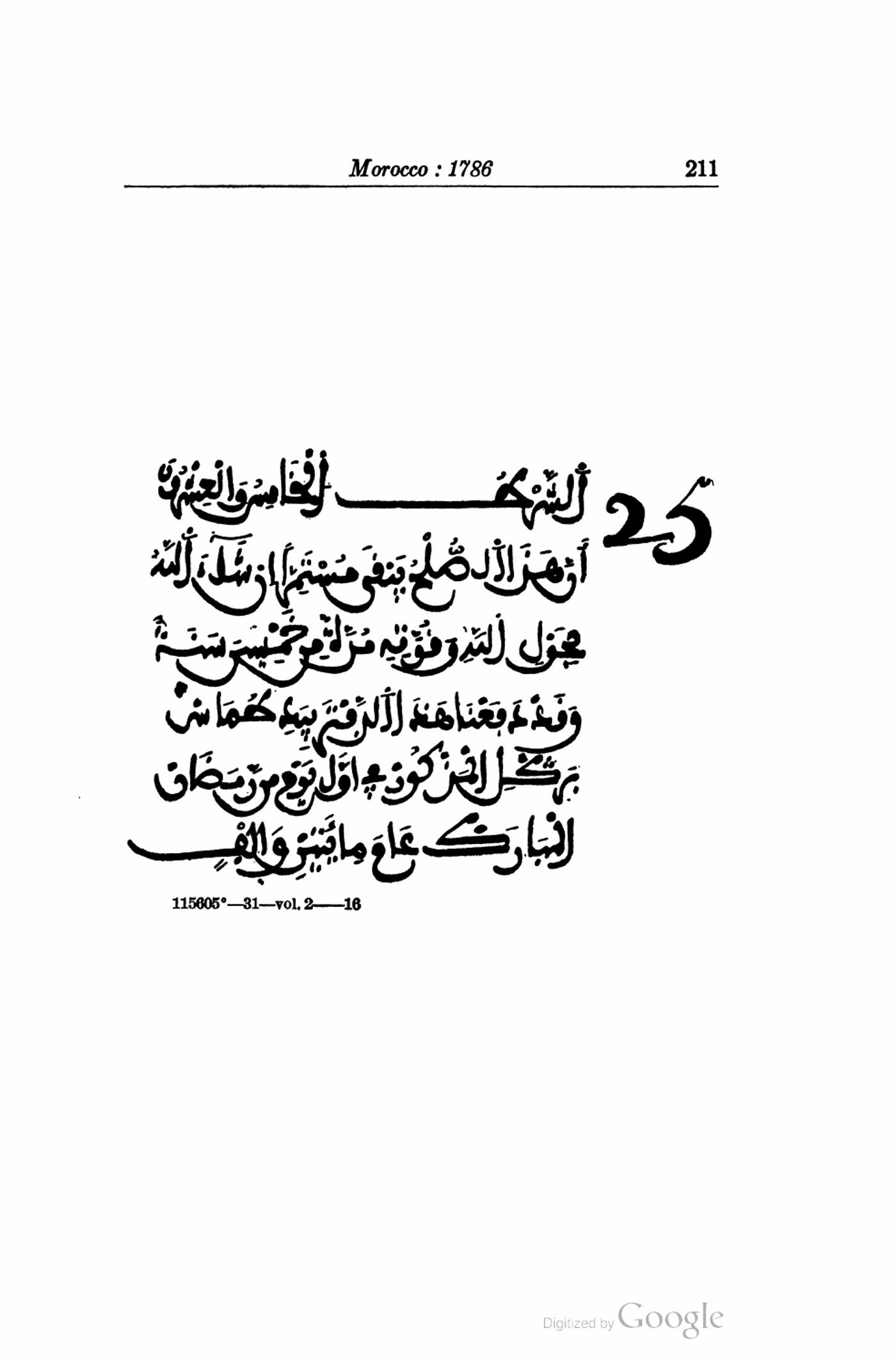
الشرط الخامس والعشرون — أنه يدوم هذا الصلح دائماً بقادرية الله تعالى وقوته مدة خمسين سنة
The 1786 treaty-form face (witness B, folio ٢٥, print 211) [W/S as marked]. VARIANCE OF RECORD: the carried frozen pin (CORPUS line 69) reads أن هذا الصلح إن شاء الله يظل دائما … — the face reads يَدُوم … دَائِمًا with no إن شاء الله observed; the 1786 carried English mirrors the face (“shall continue … with the help of God”), the Leiden literal mirrors the pin (“shall remain permanent, if God please”). Both disclosed; candidate dated erratum CE-1 queued at the author’s gate; the repugnancy anchor (permanent … fifty years) is unaffected. The 1836 recordation adds the twelve-month-notice tail — the addition of record (Miller, vol. 4, prints 59, 63–65).
The 1786 treaty-form face, folio ٢٥ (Miller, vol. 2, print 211; DOR-AF PDF 28).
Verify: DOR-AF PDF 28 (= print 211, folio ٢٥) · the 1836 notice-tail collation: Miller vol. 4, prints 59, 63–65.
Word by word — the doctrine-bearing units
Arabic
Transliteration
Gloss and carried English
Flag
يَدُوم
yadūmu
“endures” — the face’s duration verb
[S]
دَائِمًا
dāʾiman
“permanently” — the duration adverb BOTH readings carry; the preamble’s own word for the grant
[W]
بِقَادِرِيَّةِ اللهِ تَعَالَى وَقُوَّتِهِ
bi-qādiriyyati Llāhi taʿālā wa-quwwatihi
“by God’s might — exalted is He — and His power” — the help-of-God formula; carried “with the help of God”
[W]
مُدَّة خَمْسِين سَنَة
muddata khamsīna sanah
“a period of fifty years” — the cap that meets the dāʾima declaration
[W]
**The repugnancy visible on the face of the clause itself:** *permanent … fifty years*. The grant declared dāʾima by its own preamble meets a duration cap — and the adjudication of record: the condition falls, the grant stands — al-sharṭu bāṭil wa-l-ḥibatu ṣaḥīḥa (never void ab initio, never severance). The twelve-month-notice tail appears first in the 1836 recordation — absent the 1786 instruments — and falls with the same rule. **SUMMARY — the full rule with its evidences: ḤIBAH chs. 10, 20, 30 · the 2026-08-03 correction of record · studied in Module II.**
The delivery clause
The delivery — the book handed to Barclay (perfection of the grant)
“We have delivered this Book into the Hands of the before-mentioned Thomas Barclay on the first day of the blessed Month of Ramadan, in the Year One thousand two hundred.”
— The delivery clause of record (1786), followed on the same page by Barclay’s translator certificate.
… توماس باركلي المذكور … شهر رمضان المبارك … غرة رمضان سنة ١٢٠٠
The delivery clause (the 1786 treaty-form face, same folio) [S anchors]. Carried English: “We have delivered this Book into the Hands of the before-mentioned Thomas Barclay on the first day of the blessed Month of Ramadan, in the Year One thousand two hundred.” The same page carries Barclay’s certificate naming the translator of record, Issac Cardoza Nuñez, Interpreter at Morocco.
The close of the instrument on the same folio face (folio ٢٥, print 211; DOR-AF PDF 28).
Verify: DOR-AF PDF 28 · Barclay’s translator certificate as carried (the 1786 English close).
Word by word — the doctrine-bearing units
Arabic
Transliteration
Gloss and carried English
Flag
غُرَّة رَمَضَان سَنَة ١٢٠٠
ghurrata Ramaḍāna sanata 1200
“the first of Ramadan, year 1200” (1786) — the hand-over date of the sealed book
[S]
The delivery clause is the instrument’s **attestation of hand-over** — the perfection-of-grant moment: in the hiba analysis, delivery/possession (qabḍ) is what perfects. **SUMMARY — the full rule with its evidences: ḤIBAH ch. 6.**