EMPIRE OF MOROCCO
Ab Antiquo • Maghrib Al-Aqṣā • North Gate
1786 Mālikī Sharia Hiba (Sovereign Unilateral Grant) · Recorded at 8 Stat. 484 (1836)
INTERNATIONAL DOCUMENT · ARTICLE 4 ʿALĀMA (MARK OF RECOGNITION) · GRANT INSTRUMENT
Instrument No.: ______________ (1)
PRIMARY BENEFICIARY: ______________ (2) — Moorish Subject of the Empire of Morocco
Moorish American Appellation: ______________ (3)
ARTICLE 4 ʿALĀMA — "ʿalāma baynanā naʿrifu bihā" — "a mark between us by which we know each other"
Moorish Divine and National Movement of the World
Northwest Amexem / Northwest Africa / North America / 'The North Gate'
'Temple of the Moon and Sun'
Societas Republicae Ea Al Maurikanos
The True and De jure Natural Peoples — Heirs of the Land
I.S.L.A.M.
LEGAL NOTICE!
NATIONALITY DECLARATION, NAME CORRECTION,
PROCLAMATION AND PUBLICATION
Issued under the 1786 Mālikī Sharia Hiba (Sovereign Unilateral Grant) of the Empire of Morocco
Note on dating. The controlling instrument is the 1786 Mālikī Sharia Hiba — a unilateral sovereign grant sealed by Sidi Mohammed III at Marrakesh on 23 June 1786 (25 Shaʿbān 1200 A.H.) and delivered to U.S. Agent Thomas Barclay on 28 June 1786 (1 Ramadan 1200 A.H.). The 1786 Arabic is the sole sovereign instrument of grant in the United States–Empire of Morocco record; the 1836 Arabic stands reproduced of record (Miller, vol. 4, Doc. 81, print pp. 34–59) as recordation, not grant. The English-language document codified at 8 Stat. 484 (1836) is a ministerial recordation — a grantee-internal entry into the U.S. statutory record stack performed entirely by U.S. officials. It carries no sovereignty, performs no second grant, and does not alter the unilateral character of the 1786 hiba. The Arabic original controls; English documents are non-authoritative.
I. Opening Declaration
I, ______________ (2) (Moorish American Appellation: ___________ (3)), being a direct descendant of the Ancient Canaanites / Moabites, assert my Birthright Claim of Right and of Title. Standing squarely and duly affirmed, I do declare and proclaim, upon Divine Law; upon Nature’s Law; upon Universal Law; upon my Moorish Birthrights; upon International Law; upon the 1786 Mālikī Sharia Hiba (Sovereign Unilateral Grant) of the Empire of Morocco, sealed by Sidi Mohammed III at Marrakesh on 23 June 1786; upon the U.S. Constitution, Article VI, Clause 2 (Supremacy Clause); and upon the doctrine of estoppel by admission against the United States, the chain of which is documented in Section III herein; declare, proclaim, and say:
I, ______________ (2), being previously misclassified and misidentified by persons of the Union States Society, U.S.A — doing business at North America, was falsely designated under the colorable Ward-ship name, ________________ (4), and do hereby refute the said misclassifications and frauds; making it known to the Public; and publish my Corrected Free National Name, Attribute, and Title.
Let it be declared, known, published, and resolved that I Am: ______________ (2), "In Propria Persona" Sui Juris, Sui Heredes, In Solo Proprio (being in my own proper person), by birthright; and by Heirship Inheritance, AND WITHOUT IMPOSITION OF THE FOREIGN, IMPOSED COLOR-OF-LAW, COLOR OF AUTHORITY, NOR BY ANY ASSUMED OR COLORABLE JURISDICTIONS OR DUE PROCESSES of the foreign Union States Society persons doing business at North America / Northwest Amexem.
Scope of this declaration — the law and venue of the grant. This instrument claims no exemption from law and no immunity from legal process; it invokes the law and the venue the hiba itself establishes. Venue lies in the consular jurisdiction of Article 20 — "the Consul of his nation shall pass sentence upon him" — and in adjudication under Article 21, by which the party "will be sentenced according to the rules of the Sacred [Mohammedan] Law, neither more nor less," the trial "to take place in the presence of the Consul." The 1786 Mālikī Sharia Hiba operates as the supreme Law of the Land (U.S. Const. art. VI, cl. 2): the municipal framework’s own charter subordinates itself to the treaty. This declaration acts at the sovereign layer of the grant; it is not a claim within the municipal system, and it submits to no domestic classification or venue the hiba displaces. The designation 1786 Mālikī Sharia Hiba names the sovereign grant and the classical Mālikī fiqh by which it is construed (lex loci contractus) — the grant’s own law, named in the grant’s own terms, for the affiant bearing the appellations El, Al, Bey, Dey, or Ali.
II. The 1786 Mālikī Sharia Hiba — Foundational Sovereign Grant
The legal foundation of this declaration is the 1786 Mālikī Sharia Hiba. The grant is a unilateral sovereign act of the Empire of Morocco. It is not a treaty in the bilateral sense. It is a one-way conveyance of rights from the superior sovereign — the Emperor of Morocco — to the inferior grantee — the United States of North America. The instrument bears only the Emperor’s seal. The American commissioners were not asked to sign or seal the Arabic original.
Under classical Mālikī fiqh — the grantor’s legal tradition, which governs the construction of the hiba by lex loci contractus — the structure of the act is: wāhib (grantor: Sidi Mohammed III); mawhūb (subject: sovereign protections, nationality, hereditary estate, free passage, MFN footing, consular jurisdiction); mawhūb lahu (donee/beneficiary: the Moorish nation, identified by appellative markers El, Al, Bey, Dey, Ali); qabḍ (constructive delivery: perfected 28 June 1786); ʿiwaḍ (no consideration: the hiba is unilateral by definition). Upon qabḍ, the hiba became tāmm (complete), lāzima (binding), mustaqirra (settled), dāʾima (permanent), and ghayr qābila li-l-rujūʿ (non-revocable).
Under the law of grants, this instrument is vertical and non-invertible: the Emperor retains superior sovereignty; the United States received only delegated usufruct rights and a franchise. The grantee can never become the grantor.
II.A. The Arabic Text Controls; the English Text Carries No Sovereignty
The Arabic original sealed by Sidi Mohammed III on 23 June 1786 is the sole sovereign act of grant in the United States–Empire of Morocco record. The English-language documents in the U.S. archives are not parts of the grant; they are grantee-internal documents about the grant. None bear the grantor’s seal. None can speak as or for the grantor. Under lex loci contractus the grant is governed by Mālikī fiqh, not by U.S. domestic contract law imported via grantee-curated English drafting.
II.B. The Period Meaning of "Renewal" — Administrative, Not Substantive
The U.S. State Department’s use of "renewal" in connection with the 1836 event is a term of art for administrative re-recordation, not substantive re-granting. Under classical Mālikī fiqh, the 1786 hiba was tāmm (fully perfected) upon qabḍ on 28 June 1786. A tāmm hiba is non-repeatable: the legal act has no incomplete state on which a second act of grant could operate. President Jackson dispatched James R. Leib in 1835 with explicit instructions to "obtain a renewal of the old treaty exactly as it stands" — the presidential-level admission that the directive was re-recordation, not negotiation. Hunter Miller’s official edition characterizes the 1836 instrument as "almost literally a renewal" (vol. 2, GPO 1931) — the period’s own word: continuation, not re-granting.
II.C. The Article 25 Fifty-Year Clause — A Repugnant Condition; the Condition Falls, the Grant Stands
The fifty-year duration clause stands in the sealed Arabic of Article 25 — and it is a condition repugnant to a perfected hiba. The 1786 Arabic preamble closes the substantive grant with dāʾima — "trusting in God it will remain permanent" (certified translation; Miller, vol. 2, Doc. 14). Under the Mālikī rule of repugnant conditions, a condition contrary to the expressed nature of a perfected grant falls, and the grant stands: the clause falls, the hiba endures, and the integrity of the sealed instrument is affirmed rather than impeached. A term limit on a perfected hiba is a logical impossibility. The same applies a fortiori to the twelve-month termination-notice clause, which appears for the first time in the 1836 recordation — Arabic text, Article 25 (Miller, vol. 4, print p. 59), with Miller’s editorial note recording it as an 1836 addition (print p. 65) — and nowhere in the 1786 instruments.
II.D. The 1836 Arabic — Reproduced of Record; a Ministerial Recordation, Not a Second Grant
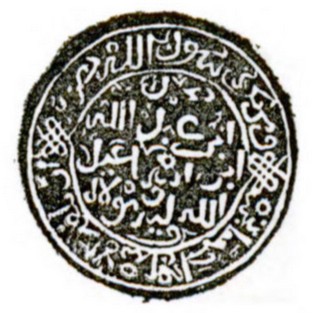
The 1836 Arabic text stands reproduced of record in the official United States edition — Hunter Miller, Treaties and Other International Acts of the United States, vol. 4 (GPO, 1934), Document 81: Arabic text at print pp. 34–59, bearing the Emperor’s seal at print p. 34 (partially legible in halftone); English translation at print pp. 60–66 — with Miller’s editorial note that the original treaty with the seal of the Emperor of Morocco remains in the file papers (vol. 4, print p. 66). The 1836 instrument is a ministerial recordation — a U.S.-internal entry into the statutory record stack performed entirely by U.S. officials (Consul Leib; the U.S. Senate; President Andrew Jackson). It carries no sovereignty, performs no second grant, and neither adds to nor subtracts from the perfected 1786 hiba. No new grant was required, and none was made: the 1786 hiba was perfected upon execution and delivery to the U.S. agent, the rights vesting immediately (1 Ramadan 1200 A.H. / 28 June 1786), and is irrevocable. Consequently, any term appearing in the 1836 recordation purporting to condition, limit, or terminate the perfected grant — including the fifty-year duration clause and the twelve-month notice clause, each first appearing in the 1836 recordation (Arabic text, Article 25) and nowhere in the 1786 instruments — is a condition repugnant to the essential nature of the hiba and is void and stricken under the classical Mālikī rule of repugnant conditions (al-sharṭu bāṭil wa al-hibatu ṣaḥīḥa — "the condition is void and the gift is valid"): the clause falls, the grant stands. The recordation itself is not stricken; it stands as own-side authentication of the continuing record — triple-authenticated by the treaty recital, Consul Leib’s despatch, and the State Department file note. The sealed 1836 original has not been produced for independent inspection, and the reproduced seal is only partially legible; every presumption regarding the content of the unproduced original runs against the party withholding it (omnia praesumuntur contra spoliatorem; Mālikī parallel: al-amīn lā yuṣaddaq fī mā yuṭālab bihi illā bi-bayyina). The grantor’s sovereign voice of grant in the United States–Empire of Morocco record is the 1786 dāʾima hiba; the Arabic original controls.
III. Twelve U.S. Admissions — Estoppel by Admission
The grant character of the 1786 instrument is not asserted; it is admitted. Twelve admissions, by authorized U.S. agents across 229 years (1785–2014), bind the United States under estoppel by admission. Admissions 1–5 are presented in detail with full quoted texts; admissions 6–12 are presented in tier-2 short form, with equal legal effect.
Admission 1 — 1785 · The U.S. Sought a Bilateral Treaty
We the United States of America in Congress Assembled… giving and granting to them… full Power and Authority… to confer, treat and negotiate with the Ambassador, Minister, Commissioner, or other Agent of His Majesty the Emperour of Morocco, of and concerning a Treaty of Amity and Commerce…
— American Commissioners’ Letter of Credence (Adams, Franklin, Jefferson), March 11, 1785. Founders Online, National Archives.
Effect: The U.S. sought a bilateral Treaty of Amity and Commerce. The Emperor delivered a unilateral sovereign grant instead. The U.S. accepted what was delivered.
Admission 2 — 1786 · The American Agent Refused to Sign an Acceptation
I was asked to sign an acceptation of the articles on the part of the United States; but as the treaty was not drawn up in the form expected, I excused myself.
— Thomas Barclay, U.S. Agent, to John Adams & Thomas Jefferson, September 18, 1786. Founders Online, National Archives.
Effect: Contemporaneous admission by the U.S. agent who physically received the sealed book that the instrument was not in bilateral form.
Admission 3 — 1789 · President Washington Acknowledges Inferior Grantee Status
May the Almighty bless your Imperial Majesty, our great and magnanimous Friend, with his constant guidance and protection. … Within our Territories there are no Mines, either of Gold, or Silver, and this young Nation, just recovering from the Waste and Desolation of a long War, have not, as yet, had Time to acquire Riches by Agriculture and Commerce.
— President George Washington to Emperor Sidi Mohammed III, December 1, 1789. Founders Online, National Archives.
Effect: The first U.S. President expressly acknowledged the United States as the inferior debtor/grantee party and the Emperor as the superior creditor/grantor.
Admission 4 — 1836 · U.S. Consul Confirms Grant Form
The Treaty, it will be observed, being sealed by the Emperor according to the diplomatic custom observed in this Empire, bears the form of a grant. Hence, it would be out of rule to deface the original with my signature or seal.
— James R. Leib, U.S. Consul at Tangier, Despatch No. 39, October 11, 1836.
Effect: At the very moment of the 1836 event, the U.S. Consul confirms in writing that the instrument "bears the form of a grant."
Admission 5 — 1931 · State Department Treaty Editor
The theory seems to have been somewhat similar to our notion of a unilaterally executed grant and its delivery, for the text in the "book" was not signed or sealed on behalf of the other party.
— Hunter Miller, Treaties and Other International Acts of the United States, Vol. 2, p. 225 (GPO, 1931).
Effect: The U.S. State Department, in its official treaty publication, expressly characterizes the instrument as "a unilaterally executed grant and its delivery."
The following seven admissions (6–12) carry equal legal effect to admissions 1–5, presented in short form for compactness.
Admission 6 — 1802–1805 · First Barbary War Settlement — Grant Treated as Operative. The U.S. naval response to Mawlay Sulayman’s 1802 declaration and the subsequent diplomatic settlement treated the underlying 1786 grant as still operative. The U.S. did not argue that the fifty-year clause had been triggered into a renegotiation posture. Conduct-based admission of perpetuity during the fifty-year term — predating 1836 and foreclosing any U.S. argument that the fifty-year clause was treated as substantively operative.
Admission 7 — 1835 · Jackson Administration Instructions to Leib. President Jackson’s instructions to U.S. Consul James R. Leib, August 10, 1835 (D.S. 14 Instructions, Barbary Powers, 5–7): "obtain a renewal of the old treaty exactly as it stands." The phrase "exactly as it stands" is a presidential-level admission that the U.S. directive was for re-recordation of the existing instrument unchanged — not negotiation of a new one.
Admission 8 — 1837 · Senate Advice and Consent + Presidential Proclamation. The U.S. Senate’s Resolution of Advice and Consent of January 17, 1837, and President Jackson’s Proclamation of January 30, 1837, formally adopted an instrument the Consul himself had characterized as "bearing the form of a grant" (Admission 4). The strongest estoppel in the chain: cross-branch institutional admission at the maximum strength the U.S. constitutional structure can produce.
Admission 9 — pre-1931 · State Department Retention of Snouck Hurgronje. The U.S. State Department retained Dr. C. Snouck Hurgronje, the Dutch Orientalist, specifically to translate and analyze the 1786 Arabic original. The act of retention is itself an admission that (i) the Arabic is the controlling text, and (ii) the U.S. lacked internal capacity to interpret the instrument without recourse to a specialist in the grantor’s legal and linguistic tradition. The U.S. State Department admitted Arabic primacy with its checkbook.
Admission 10 — 1952 · ICJ — Rights of Nationals of the U.S. in Morocco. In Rights of Nationals of the United States of America in Morocco (France v. United States), Judgment of August 27, 1952, I.C.J. Reports 1952, p. 176, the United States argued affirmatively before the International Court of Justice that the 1786/1836 instrument remained binding and that U.S. nationals retained rights under it. The U.S. sovereign-level litigating position before the ICJ creates international-law estoppel under "allegans contraria non audiendus est" in addition to domestic estoppel by admission.
Admission 11 — 1953–2025 · Treaties in Force — Continuous Annual Reaffirmation. The U.S. Department of State has listed the 1786/1836 instrument in Treaties in Force continuously from publication to the 2025 edition (Morocco · Peace, p. 301). Each annual edition is a fresh State Department admission that the instrument is on the records as in force. For any hypothesized lapse date a future U.S. position might identify, Treaties in Force for that year and every subsequent year is the U.S.’s own published contradiction.
Admission 12 — 2014 · Library of Congress Certified Reproduction. On September 4, 2014, the Library of Congress issued a certified reproduction of 8 Stat. 484, signed by Gregory T. Cooper, Section Head, Office of Business Enterprises, at the request of the affiant. The certification is a federal institutional act affirmatively attesting that the instrument exists, is on the federal record, and is producible from federal custody. The most recent admission in the chain — forecloses any U.S. argument that the instrument has been administratively retired, lost, or superseded.
Cumulative Estoppel Effect
The twelve admissions constitute continuous, cross-branch, and hierarchical estoppel against the United States. Each independently creates estoppel sufficient to bind the U.S. on the fact admitted. Read together, they create a layered estoppel architecture spanning 229 years (1785–2014), covering every branch of the federal government, every level of the constitutional hierarchy.
There is no point in the constitutional history of the United States at which an authorized U.S. agent has departed from the positions admitted in this chain. The U.S. cannot now adopt a contrary position without contradicting its own 229-year continuous record. Under estoppel by admission — and, with respect to Admission 10, under allegans contraria non audiendus est — the United States is foreclosed from any contrary position.
IV. Trust / Beneficiary Doctrine — The Affiant’s Equitable Interest
Under the law of trusts and grants, the United States holds only delegated usufruct rights and a franchise as trustee for the true beneficiaries of the grant: the Moorish people — subjects of the Empire of Morocco who reclaim their national identity. The grant vests equitable ownership in the Moorish nation, not merely legal title in the U.S. government.
The affiant, ______________ (2) (Moorish American Appellation: ___________ (3)), is a beneficiary of the 1786 Mālikī Sharia Hiba by blood, by primogeniture, by birthright, and by heirship inheritance. This declaration constitutes the affiant’s public and recorded qabḍ of the grant’s benefits as they vest in his person.
Effect: The affiant’s status as a beneficiary of the 1786 Mālikī Sharia Hiba is independent of, and superior to, any U.S. domestic classification. The U.S., holding only delegated legal title as trustee, cannot adversely classify, re-name, or impose colorable jurisdiction on a beneficiary of the grant for which it serves as trustee. To do so is a breach of trust and is voidable at the election of the beneficiary.
IV.A. Register of This Doctrine — Analytical Model of the Grant, Not a Court-of-Equity Trust
The trust and beneficiary framing of this Section IV states the analytical model of the grant’s structure — the allocation of burdens and benefits that the 1786 hiba itself effects, construed under classical Mālikī fiqh as the law of the place of contracting (lex loci contractus). No trust cognizable in a court of equity is asserted or required, and the discretionary doctrines of equity — laches, clean-hands balancing, and remedial discretion — are expressly disclaimed as inapplicable to a completed sovereign grant (hiba tāmm, lāzima, ghayr qābila li-l-rujūʿ). The beneficiary’s remedy of record is the grant’s own machinery: treaty supremacy (U.S. Const. art. VI, cl. 2), consular jurisdiction (Articles 20–21), and estoppel by admission (Section III herein).
V. Rules of Construction — Twelve Maxims, All Adverse to the Grantee
The construction of the 1786 Mālikī Sharia Hiba is governed by twelve interlocking rules, drawn from the period authorities and the grantor’s legal tradition. Every rule operates in the same direction: adverse to the grantee.
1. Bynkershoek's Interpretatio Stricta (Quaestionum Juris Publici, Book II, Ch. 7 (1737)). A sovereign grant is construed most strongly against the grantee. The native rule for sovereign-grant construction — the inverse of the contract-law rule of contra proferentem, which has no application to a unilateral sovereign act.
2. Bynkershoek's Anti-Self-Interpretation Rule (Quaestionum Juris Publici, Book II, Ch. 10). No party to a grant may serve as the sole interpreter of its own obligations.
3. Grotius' Common-Usage Rule (De Jure Belli ac Pacis, Book II, Ch. 16 (1625)). The grant means what its words meant in 1786, in Arabic, under Mālikī fiqh.
4. Vattel's Effective-Interpretation Rule (Le Droit des gens, Book II, Ch. 17 (1758)). No interpretation may render any clause meaningless or defeat the grant’s purpose.
5. The Intertemporal Rule (Grotius; Island of Palmas (1928)). The 1786 hiba is governed by 1786 Mālikī fiqh and the 1786 law of nations — not by U.S. doctrines that postdate the grant.
6. Nullum Tempus Occurrit Regi (Blackstone Book I, Ch. 7; Coke, Institutes Part I §90b). No time runs against the sovereign. The grant does not lapse by laches, limitations, or non-assertion.
7. Enrollment as Permanent Evidence (Blackstone Book II, Ch. 20). The enrolled record is "perpetual testimony." The Library of Congress’s 2014 certification is the federal record of the enrollment.
8. Exhaustive Termination List (Volume K, Ch. 8 (Architecture of Peace)). The period authorities recognize a closed list of events that do NOT terminate a sovereign grant: (1) passage of time; (2) non-performance by grantee; (3) non-performance by grantor; (4) domestic legislation by grantee; (5) succession crises; (6) war; (7) unilateral renunciation by grantor. None terminates the grant.
9. The Ten Fiduciary Duties (Volume K, Ch. 10). Loyalty, Care, Accounting, Good Faith, Preservation, Disclosure, Identification, Non-Conversion, Non-Delegation, Impartiality. Each independently enforceable. The U.S. has breached multiple duties simultaneously.
10. The Spoliation Maxim (Omnia praesumuntur contra spoliatorem; The Pizarro 15 U.S. 227 (1817); Volume K, Ch. 16). All presumptions run against the despoiler — the party that fails to produce primary documents within its custody.
11. Al-Amīn Lā Yuṣaddaq Illā bi-Bayyina (Classical Mālikī fiqh). The trustee is not believed in what is demanded of him except by clear evidence. The Mālikī parallel of the spoliation maxim.
12. Misidentification Doctrine — Fiduciary Standard Governs (Volume K, Ch. 11). Where a trust exists, the fiduciary standard governs and the contractual standard is irrelevant. The U.S.’s recharacterization of the relationship as bilateral and contractual is the analytical error Volume K specifically names.
VI. Authorities — Pursuant to
This declaration is made pursuant to, but not limited to:
1. 1786 MĀLIKĪ SHARIA HIBA — Sealed by Sidi Mohammed III, Emperor of Morocco, at Marrakesh, 25 Shaʿbān 1200 A.H. (23 June 1786); delivered to Thomas Barclay, U.S. Agent, 1 Ramadan 1200 A.H. (28 June 1786). Original in Arabic. Source: Hunter Miller, Vol. 2 (GPO, 1931); Bevans, Vol. 9 (State Dept., 1972). Foundational unilateral sovereign grant. Sole sovereign instrument of grant. Controlling text in Arabic.
2. 8 STAT. 484 — MINISTERIAL RECORDATION (1836) — English-language document codified at Statutes at Large Vol. 8, pp. 484–487. Signed and sealed by U.S. Consul James R. Leib at Tangier, 1 October 1836; ratified by U.S. Senate, 17 January 1837; proclaimed by President Andrew Jackson, 30 January 1837. Library of Congress certified reproduction, 4 September 2014. Grantee-internal ministerial recordation; carries no sovereignty.
3. TWELVE U.S. ADMISSIONS — ESTOPPEL CHAIN — See Section III herein. Continuous, cross-branch, and hierarchical admissions spanning 229 years (1785–2014).
4. CONSTITUTIONAL AUTHORITY — U.S. Constitution, Article VI, Clause 2 (Supremacy Clause); Article III, Section 2; Amendment V; Amendment IX.
5. IRREVOCABILITY DOCTRINE — U.S. SUPREME COURT — Fletcher v. Peck, 10 U.S. 87 (1810); Society v. Town of Pawlet, 21 U.S. 464 (1823); Chae Chan Ping v. United States, 130 U.S. 581 (1889); Cook v. United States, 288 U.S. 102 (1933); Charles River Bridge, 36 U.S. 420 (1837); Worcester v. Georgia, 31 U.S. 515 (1832); Jones v. Meehan, 175 U.S. 1 (1899).
6. INTERNATIONAL PRECEDENT — PIOUS FUND — The Pious Fund Case (United States v. Mexico), Permanent Court of Arbitration, The Hague, 1902.
7. ARCHITECTURE OF PEACE SERIES — Volume J (The Host and the Guest); Volume K (Grants and Trusts) — locked canonical editions.
8. INTERNATIONAL HUMAN RIGHTS — Universal Declaration of Human Rights (1948), Article 15; UN Declaration on the Rights of Indigenous Peoples (2007), Articles 4 and 5.
9. MOORISH-AMERICAN INSTRUMENTS — Free Moorish-American Zodiac Constitution (C.M. Bey); House Resolution Number Seventy-Five (75), 17 April 1933; U.S. Department of Justice, Moorish American Credentials, Copyright AA 222141.
VII. Judicial Notice and Proclamation
To: Public Servants and Officers of Trust doing business as, of, and for the Federal, State, City, and Municipal Governments; their Personnel, Contractors, and associate Corporate Entities doing business at North America. Concerning their Fiduciary Obligations, Official Oaths, and Duties enumerated in the American Constitution; all Binding Grants — including the 1786 Mālikī Sharia Hiba and its 1836 ministerial recordation at 8 Stat. 484.
Upon my Heirship, inherited Nobility, and upon my Private Aboriginal/Indigenous Proper Person Status, I, ______________ (2), pledge my National, Political, and Spiritual Allegiance to my Moabite/Moorish Nation; standing squarely affirmed upon my Oath to the "Five Points of Light" — Love, Truth, Peace, Freedom, and Justice; do squarely affirm to tell the truth, the whole truth, and nothing but the truth; being competent in my own proper person to attest to this Affidavit upon which I place my signature.
That I, ______________ (2), am a Noble of the Empire of Morocco (North America) In Propria Persona; being Moorish American — an Heir and Descendant of the Ancient Moabites/Moors, by Birthright, by Freehold, by Primogeniture, and by Inheritance. My status as a national of the Empire of Morocco and as a beneficiary of the 1786 Mālikī Sharia Hiba is the gateway to all protections under the grant; any dispute is subject to consular jurisdiction (Article 20), not domestic venue.
VIII. Grant Nexus — Operative Provisions
This declaration is issued under the protection of the 1786 Mālikī Sharia Hiba. The following provisions are directly operative:
Article 4 (ʿAlāma): This instrument is itself an Article 4 ʿalāma — ʿalāma baynanā naʿrifu bihā ("a mark between us by which we know each other").
Article 6 (Nationality Gateway): Nationality is the gateway to all grant protections.
Article 14 (MFN Footing): Affiant’s nationality and name entitled to same recognition as any other national.
Article 17 (Free Trade): Freedom to trade without compulsion.
Article 20 (Consular Jurisdiction): Disputes subject to consular venue, not domestic proceedings.
Article 21 (Personal Accountability): Adverse action subject to consular review.
Article 22 (Hereditary Estate): Hereditary chain and estate custody are grant-protected.
Article 24 (Indulgence Parity): Any recognition extended to others extends automatically to affiant.
Article 25: Dāʾima — "permanent" in the sealed Arabic preamble (certified translation; Miller, vol. 2, Doc. 14). The fifty-year clause stands in the sealed Arabic and falls as a condition repugnant to a perfected hiba; the grant stands (see Section II.C).
Notice to Agent is Notice to Principal — Notice to Principal is Notice to Agent. Service upon any agent of any governmental body constitutes notice to the body itself.
IX. Professional Credentials
The affiant holds the following credentials, each supported by a separate Ijāzah on file:
• _________________________ (5a)
• _________________________ (5b)
• _________________________ (5c)
• _________________________ (5d)
X. Solemn Declaration, Attestation, and Witnesses
Hibu (Love), Ḥaqq (Truth), Salaam (Peace), Ḥurriyatun (Freedom), ʿAdl (Justice).
All Rights Reserved Without Prejudice; U.C.C. 1–207 / 308, U.C.C. 1–103.
Attestation of Witnesses — Celestial and Terrestrial
In accordance with the ancient sovereign attestation tradition (Deuteronomy 30:19, 31:28), the following witnesses are called: perpetual, incorruptible, beyond impeachment, and beyond the reach of any earthly jurisdiction.
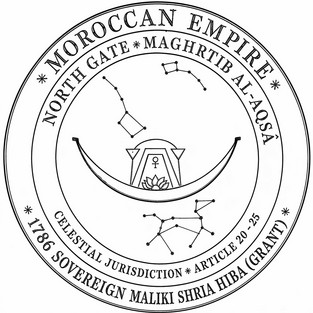
First Witness — The Great Mother (Ursa Major). The celestial guide of the northern sky, as depicted upon the Celestial Jurisdiction Seal.
Second Witness — Polaris (The North Star). The fixed point of celestial navigation, the North Gate.
Third Witness — The Earth (Terra Mater). The land of Northwest Amexem / North America, the substance of the inheritance claimed herein.
XI. Execution
I, ______________ (2) (Moorish American Appellation: ___________ (3)), by Special Appearance on this Day ______ of ________________, 2026 C.C.Y. = 1447 M.C., do hereby affirm, in Honor and before the three Celestial and Terrestrial Witnesses called herein, that I am a Descendant/Heir, Natural Person/Divine Being herein named, standing "In Full Life"; affirmed by Lawful, Substantive Right; by Birthright; being of descendible age and competence; and lawfully qualified to execute this Affidavit.
This instrument is self-authenticating under Article 4 (ʿAlāma) of the 1786 Mālikī Sharia Hiba. It does not require notarization, domestic validation, or third-party attestation.
Chronos: Day: __________ Month: __________________ Year: __________
I Am: __________________ (2), ________ (6)
__________________ (2), ________ (6) (also known as __________ (8) ___________ (3), ________ (6))
Office/Title: ______________________ (7)
Natural Person — In Propria Persona, Sui Juris, Sui Heredes — In Solo Proprio; All Rights Reserved; Free Moor/Muur
Northwest Amexem / Northwest Africa / North America / "The North Gate"
[Affix Seal or Thumbprint Here]
Seal or thumbprint — the affiant’s ʿalāma (Article 4) · 1786 Mālikī Sharia Hiba · Articles 20–25
Instrument No.: ______________ (1)